2026 Digital Marketing Trends: The 6 That Moved Budget & 4 That Did Not

Last updated:
|
10 minutes readKey Takeaways
- AI search changed search strategy, but it didn’t make traditional search obsolete.
- Retail media kept earning eCommerce budget when purchase data could justify the spend.
- CTV grew up. Buyers increasingly expected it to prove outcomes, not just reach.
- Social media ads became more dependent on creative variety and less on endless audience slicing.
- First-party data became infrastructure, not a side project for the analytics team.
- Attribution became less about finding one perfect number and more about building a measurement system you can defend.
- Generic AI creative, extreme hyper-targeting, fully autonomous media buying, and indiscriminate retail-media testing did not earn the same budget confidence.
2026 produced no shortage of marketing trends. Your inbox probably survived twelve “AI changed everything” reports before February. At OMG, we were more interested in the developments that we thought should affect your marketing budget.
We looked at where money actually moved across OMG-managed accounts, then compared those shifts with wider market data. Six trends earned more investment, and four generated considerably more conversation than commercial conviction.
The distinction is noteworthy because 14 years of experience has told us that being early is not the same as being right.
How We Identified The Digital Marketing Trends That Moved Budget
We are deliberately separating industry trends from OMG account findings.
- [OMG DATA: X active accounts analyzed]
- [OMG DATA: $X total PPC and paid social spend analyzed]
- [OMG DATA: X ecommerce accounts represented]
- [OMG DATA: X national and international brands represented]
- [OMG DATA: January 1 to July 31, 2026, or confirmed date range]
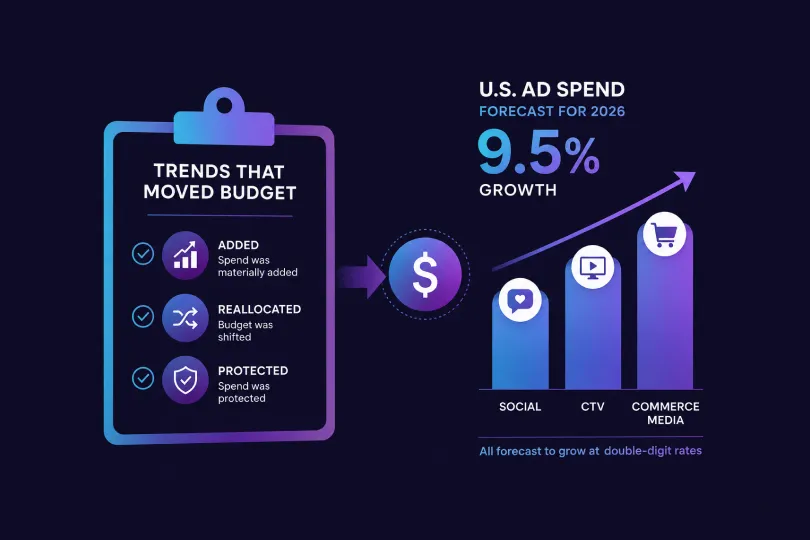
We counted a trend as having “moved budget” only when spend was materially added, reallocated, or protected because the channel, capability, or measurement approach changed a commercial decision. That bar matters, because adding an AI tool to the tech stack doesn’t count; adding $100,000 because the evidence changed does.
The broader market moved in a similar direction. The Interactive Advertising Bureau expects U.S. ad spending to grow 9.5% in 2026, with social, CTV, and commerce media all forecast to grow at double-digit rates.
The 6 Digital Marketing Trends That Moved Budget In 2026
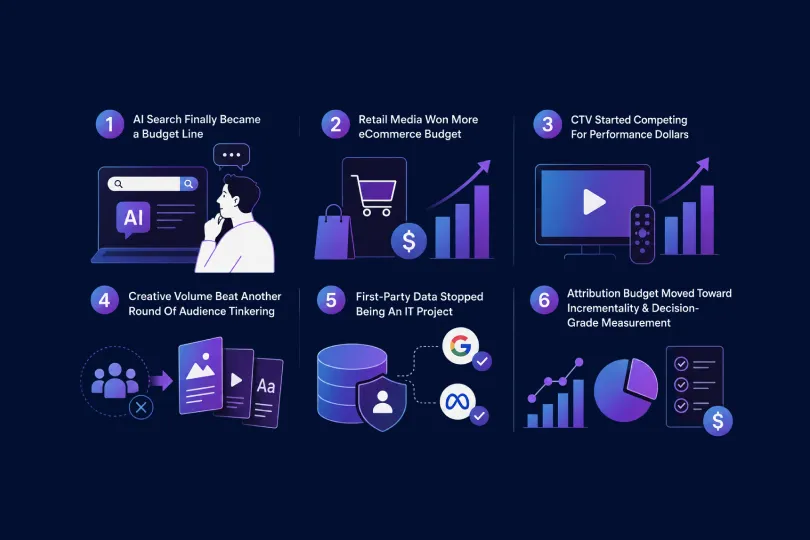
1. AI Search Finally Became a Budget Line
AI search stopped being a side conversation as it started to impact where brands were discovered and shortlisted. More of the research journey happened inside ChatGPT, Perplexity, and Google AI Mode, often before a website visit ever happened. Google says AIOs now reach more than 2.5 billion monthly active users, while AI Mode has passed one billion. That’s a lot of eyeballs.
Our accounts reflected the behavioral shift: [OMG DATA: X% of analyzed brands increased or reallocated search/content budget toward AI search and generative engine optimization (GEO), representing $X in spend or resource allocation].
The interesting part was where that money came from. For many, it was a new “GEO budget”, but smarter brands treated AI visibility as an extension of search, content, digital PR, and brand authority. From here on out, we can say GEO isn’t a shiny side project but should be another place your existing search investment has to perform.
2. Retail Media Won More eCommerce Budget, But Only When The Math Closed
Commerce media was by no means new in 2026, but the budget confidence was. The appeal is fairly obvious. Retail media sits close to the transaction and can use first-party shopper data to connect advertising with purchases. U.S. commerce-media revenue grew 18% in 2025 to $63.4 billion, while another 12.1% increase in commerce-media spend is forecasted during 2026.
However, we did not treat every retail network like free money. At OMG, the budgets followed usable purchase signals, measurable incrementality, and margin. A lovely ROAS inside a retailer dashboard is less lovely when most of those customers would have bought anyway.
3. CTV Started Competing For Performance Dollars
Connected TV used to sit dangerously close to the “brand awareness, trust us” section of the media plan. That changed. CTV grew roughly 11% to 13.8% in 2026, depending on the dataset and reporting period, while total U.S. digital video spending is expected to exceed $80 billion.
The reason more performance teams started taking CTV seriously is that it became easier to ask harder questions of the spend. Who actually saw the ad? Did exposed households visit the site? Did branded search increase? Did sales move in the test market? Did the campaign reach new customers, or just people who were already going to buy?
The catch, however, is accountability, because about 43% of buyers had only “somewhat to no confidence” in inventory quality even across some of the more trusted CTV buying methods. That means a strong-looking reach number isn’t enough on its own. Buyers still need to interrogate placement quality, duplication, frequency, attribution, and incrementality before scaling.
4. Creative Volume Beat Another Round Of Audience Tinkering
For years, paid social teams could spend alarming amounts of time creating tiny audience variations. In 2026, the bigger constraint increasingly became creative.
Across our paid social accounts, [OMG DATA: creative output increased X%, while X% of accounts shifted budget or resources from audience segmentation toward creative production/testing].
And the above data fits how the platforms themselves are evolving. Meta now explicitly recommends creative diversification alongside simplified campaign structures and automated delivery.
The lesson in 2026 is not “make more ads” but give the system more genuinely different ideas to learn from. Ten versions of the same product shot with the headline nudged three pixels to the left are technically volume. Commercially, it’s just admin. For scaling eCommerce brands, creative throughput became part of media efficiency.
5. First-Party Data Stopped Being An IT Project
For years, first-party data appeared in digital marketing trends lists somewhere between “personalization” and “prepare for a cookieless future.” In 2026, more of the conversation became operational.
Google’s Enhanced Conversions and Meta’s Conversions API both use advertiser-provided data to strengthen measurement where browser and platform signals are incomplete.
The shift was subtle but important. Businesses stopped asking, “Do we have first-party data?” and started asking, “Can we actually use it when deciding where the next dollar goes?”
6. Attribution Budget Moved Toward Incrementality & Decision-Grade Measurement
Privacy changes exposed just how fragile a lot of measurement had become. We’ve seen more teams question the numbers they once accepted at face value. Platform-reported conversions still look neat, but not useful when Meta, Google, and Amazon are all claiming a hand in the same sale.
That’s why the conversation has moved beyond “first-click versus last-click.” The harder question is whether the channel actually created incremental demand or simply happened to be standing nearby when the customer converted.
IAB’s 2026 State of Data reflects the same pressure. It describes measurement as strained by privacy regulation, signal loss, fragmented platforms, and inconsistent data. That means that in 2026, marketers need to combine attribution, incrementality, and marketing mix modeling where appropriate, then check those findings against the commercial reality.
The 4 Marketing Trends That Didn’t Quite Earn The Budget
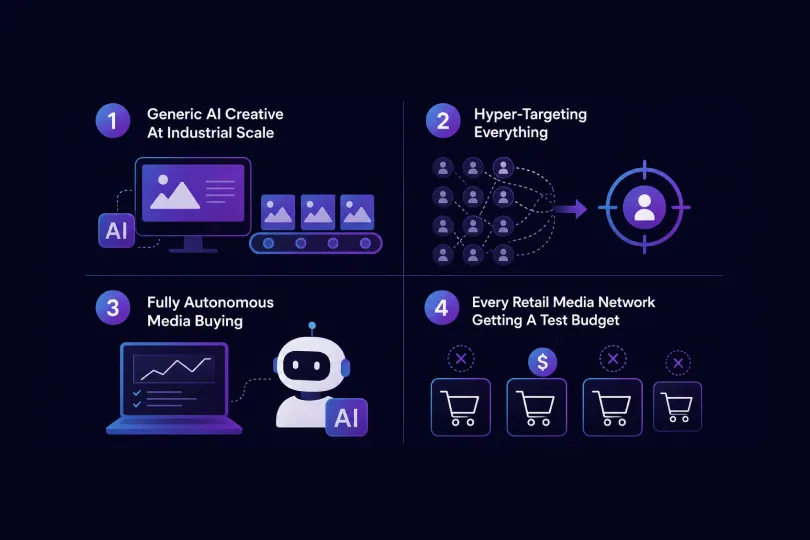
This section is where trend reports usually become polite, but we would rather be useful. Some may prove wrong by 2027, and that’s fine. A useful opinion should be falsifiable.
1. Generic AI Creative At Industrial Scale
Generative AI absolutely changed production. However, it didn’t automatically make the work better. Nearly two-thirds of digital-video buyers now use GenAI in creative production, yet research still finds a gap between how positively advertisers view AI-generated ads and how younger consumers perceive them.
We see the sameness problem firsthand. The more brands lean on the same prompts, the same models, and the same visual shortcuts, the more their creative starts collapsing toward the same center. The faces look familiar. The lighting looks familiar. The copy sounds polished but strangely interchangeable.
Our take is that AI has made mediocre creative cheaper to produce at scale. That’s not the same as making it more effective. The advantage now is using it without sanding off the distinctive ideas, brand cues, and the POV that give people a reason to notice you in the first place.
2. Hyper-Targeting Everything
We didn’t see a grand return to twenty-seven tiny ad sets, twelve interest stacks, and the media buyer proudly guarding each one like a bonsai tree. Instead, the edge moved from finding the tiniest possible audience to feeding the system better inputs. As mentioned, Meta itself recommends account simplification, automation, and creative diversification.
3. Fully Autonomous Media Buying
Agentic AI was one of 2026’s loudest marketing trends. We still kept a hand near the steering wheel. OMG accounts placed [OMG DATA: X%] of spend under fully autonomous, no-human-in-loop media decisioning.
About 96% of video buyers see some role for agentic AI, although there’s no consensus on what that role should be. Roughly 40% want humans in the loop, and 31% want explicit guardrails.
4. Every Retail Media Network Getting A Test Budget
We believe the retail-media sprawl did not deserve unlimited experimentation. There are far too many inconsistent definitions, measurements, and operating frameworks that bar scaling commerce media. Closed-loop measurement needs to be credible. Reach needs to exist. Incrementality still needs proving.
What We’re Doing Differently In 2027
With a close eye on marketing trends in 2026 (and anticipation of those still to come), our 2027 plans start with a straightforward idea: the channel shouldn’t get the budget because everybody says it’s “growing.” It should get the budget because the evidence says it deserves it.
- Search planning will increasingly treat traditional search and AI discovery as one buyer journey, rather than giving SEO, paid search, and GEO separate little kingdoms.
- For eCommerce, retail media will face a harder incrementality test. CTV will be treated as accountable video, and paid social planning will give creative production capacity a seat at the budgeting table.
- First-party data will move closer to the center of measurement, but so should CRM quality. You cannot build clever attribution on customer data held together with duplicate records and hope.
- Agentic systems will take on more execution, but we expect human oversight to become more important as the amount of automation increases. IAB’s latest video research points in the same direction, with buyers calling for audit trails and guardrails around agentic systems.
FAQs on 2026 Digital Marketing Trends
The biggest digital marketing trends in 2026 are AI search and generative engine optimization, commerce and retail media, CTV, creative diversification, first-party data activation, and more sophisticated attribution. Market-wide spending supports several of those shifts.
Move budget toward the channels proving incremental commercial value for your business. For an eCommerce company, that may mean more retail media, creative production, CTV, or social ads. You may also test newer platforms like Reddit Ads, particularly where niche communities can put you closer to specific interests. For B2B marketing trends, the strongest move may be search, GEO, LinkedIn, first-party measurement, or content that influences a long sales cycle.
Don’t copy market growth percentages into your media plan. Use them to identify where to test, then let your own metrics decide whether the test earns more money.
Tactics built around activity are losing ground to systems that can show commercial evidence. Over-segmented paid campaigns became harder to justify as platform automation improved. Generic AI-generated creative struggled to provide real differentiation. Platform-only attribution became increasingly difficult to defend. Retail-media tests without credible audience or incrementality data have become harder to scale.
Stop Funding Trends & Start Backing What Performs.
Following digital marketing trends is easy. Putting your hard-earned money behind the right ones should require evidence.
Online Marketing Gurus has worked with businesses since 2012, with 200+ specialists and 1,000+ global customers across markets. Our clients get exclusive access to Gurulytics, the AI-powered platform that brings all performance data into one view, so you can judge channels against the outcomes that matter instead of whichever platform presents the prettiest version of events. In other words, we’ll show you the data, not just tell you.
Reach out today to learn more about Gurulytics or claim your free digital marketing strategy (valued at $3,000, delivered in 48 hours). Feel free to also explore our case studies.

About the author
Read More Blogs
-


Last updated on:
-
18 minutes read
Social Media Advertising in Dallas Fort Worth: How to Measure Facebook, Instagram and LinkedIn Ads by Revenue
Last updated on:
-
27 minutes read
Digital Marketing in Dallas-Fort Worth: How Local Businesses Can Turn Market Growth Into Measurable Revenue
Last updated on:

Stop Guessing What Your Marketing Should Do Next.
Your free $4,000 strategy session shows where your digital marketing is leaking performance across search, paid media, content and conversion. You leave knowing what to fix first and what a stronger strategy could produce.