

Engineering For Google AI Mode: How To Win Citations In Query Fan-Out & Deep Search Retrieval

Last updated:
|
10 minutes readKey Takeaways
- Google AI Mode can break one complex prompt into many related searches, so pages must support the broader decision journey, not one isolated keyword.
- Google does not publish a fixed number of fan-out queries. Treat 10 to 50 as a planning model, while Deep Search can run hundreds.
- Strong optimization still starts with sound SEO, because much of how AI Mode works still leans on crawlability, useful original content, clear entities, accurate data, and trustworthy sourcing.
- GA4 cannot track citation exposure without a click. Track Search Console generative AI impressions where available, plus share of model voice, citation frequency, sentiment, and long-tail rankings.
What is AI Mode?
Google AI Mode is a conversational search experience that answers complex questions by running multiple related searches, combining the findings, and citing supporting pages. Unlike an AI Overview, which mainly summarizes a query inside the regular results page, AI Mode is designed for deeper comparison and action.
All of that changes the SEO assignment because now, brands need content that can be trusted during synthesis and cited when the answer is assembled.
AI Mode vs AI Overviews: The Architectural Difference
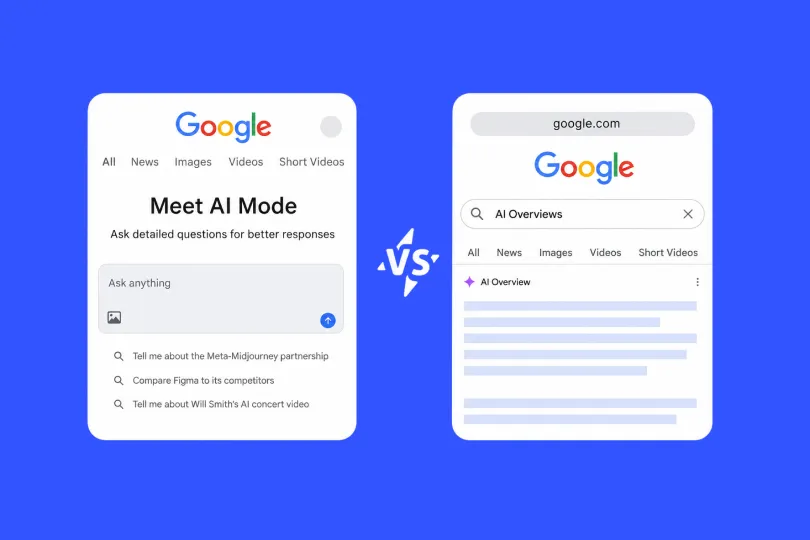
Both can use Google’s core index, ranking systems, and query fan-out. The difference is the job each experience is designed to perform. Google describes AI Overviews as a way to get the gist of a topic, while AI Mode supports further reasoning and complex comparisons.
| Dimension | AI Overviews | Google AI Mode |
| Where it appears | Inside the main Google results page | In a dedicated AI Mode experience or tab |
| Primary job | Summarise a query and provide a starting point | Research, compare, refine, and continue the task. |
| Interaction | Primarily one query, with paths into further exploration | Multi-turn conversation with context carried forward |
| Inputs | Standard search query | Text, voice, and images |
| Retrieval | May use query fan-out across related subtopics | Uses extensive fan-out for complex, multi-part prompts |
| Depth | Concise synthesis | Longer comparisons, reasoning, and Deep Search reports |
| Links | Supporting links within or around the summary | Citations and supporting links throughout the response |
| Best content opportunity | A precise passage answering the immediate question | Connected evidence that survives several retrieval paths |
Google’s guidance for websites appearing in AI features also makes one point clear: there is no secret technical gate. A page must be indexed, eligible to appear with a snippet, and built on the same SEO fundamentals that govern Search overall.
How Google AI Mode Works: Deconstructing Query Fan-out
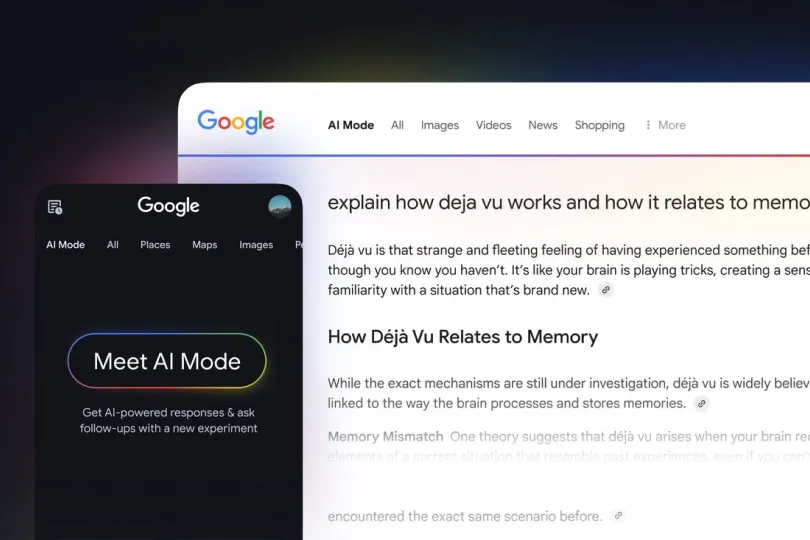
A normal search often starts with one query and returns a ranked set of documents. AI Mode can treat the same prompt as a research brief.
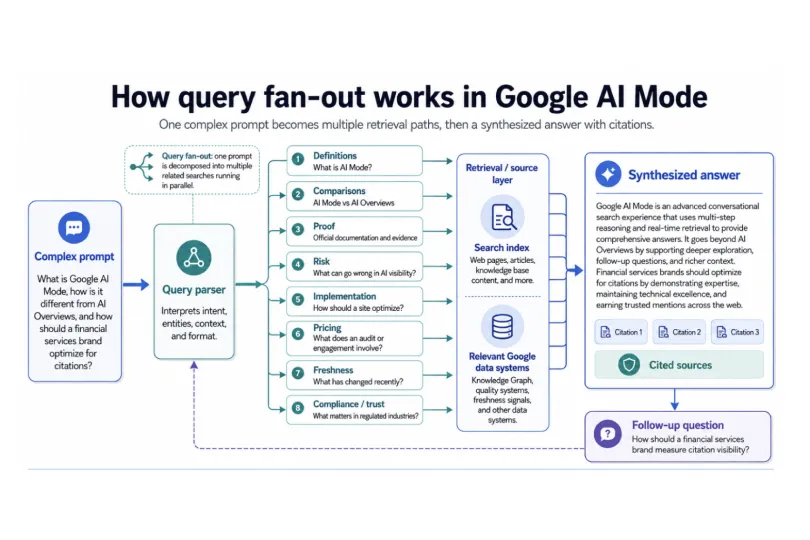
- The system parses the request. That includes the words used, the entities involved, the likely intent, and any image or voice input. A prompt such as “Which CRM is best for a 60-person financial advisory firm with Salesforce integration and strict compliance requirements?” contains several jobs hiding in one sentence.
- Query fan-out turns those jobs into related searches. Google defines query fan-out as concurrent queries generated to retrieve additional information about the user’s request. But Google does not disclose a fixed count. For planning purposes, picture a complex prompt splitting into 10 to 50 retrieval paths covering:
- Features and integrations
- Pricing and implementation
- Compliance requirements
- Reviews and alternatives
- Current product updates
- Risks and limitations
- Industry-specific use cases
That range is a useful planning model, not an official Google limit.
- The searches run in parallel across Google’s index and other relevant information systems. The model can retrieve passages from several pages rather than relying on one document to carry the entire answer. Keyword lists, therefore, aren’t dead; they’ve simply acquired a lot more relatives.
- Finally, the system synthesises the retrieved evidence into a response and renders supporting citations. For harder research tasks, Deep Search takes fan-out further. Google says it can issue hundreds of searches, reason across separate pieces of information, and produce a fully cited report.
The Five-layer Citation Stack For Google AI Mode Optimization
Google AI Mode optimization is an emerging area of expertise, but it’s not about sprinkling question headings across a page and hoping the model feels generous. It’s about building a source that remains useful as the query branches.
Use this five-layer citation stack.
1. Build multi-turn depth
Map the conversation after the first query. Someone asking, “What is AI Mode?” may next ask how it differs from AI Overviews, whether it affects traffic, how citations are selected, and what their marketing team should change.
The low-hanging fruit to pick is to answer those follow-ups in a logical sequence. Use clear sections, strong internal links, and plain-English definitions before introducing technical detail. Add examples that reflect different business conditions rather than settling for generic explanations.
What we strongly advise against is creating a thin page for every possible prompt variation. Google explicitly warns against mass-producing pages to capture fan-out queries. One substantial resource, supported by focused cluster pages where the intent genuinely changes, is stronger than a warehouse of near-duplicates.
2. Cover parallel query retrieval lanes
A fan-out system needs retrievable evidence for several subtopics. Your job is to build content around the lanes a decision-maker will investigate:
- Definition
- Mechanism
- Comparison
- Cost
- Risk
- Implementation
- Proof
- Next action
Each lane should contain a direct answer, supporting detail, and a reason to trust it. Name products, standards, methods, authors, dates, and sources where relevant. Use descriptive headings and internal links so Google can understand how the passages relate.
Remember that this isn’t keyword density with a better haircut. The goal is entity clarity and information completeness. A page should state what something is, who it applies to, where the limits sit, and what changes the recommendation.
3. Design pages that can support Deep Search reports
The bottom line is, Deep Search needs material worth researching. Think original data, documented methodology, expert commentary, case evidence, technical comparisons, and clear limitations give the system something distinct to retrieve.
Long-form content should also be easy to audit. Consider these measures:
- Use tables when they make comparison faster (not because every SEO template owns one).
- Add an author with relevant experience.
- Cite primary sources.
- Explain how conclusions were reached.
- Separate known facts from informed interpretation.
4. Expose agentic and commerce data
Google AI Mode is moving beyond answering questions and is now adding agentic experiences that can compare products, check availability, contact businesses, and support transactions. That means important business information must be both accurate and accessible.
For lead-generation brands, keep service details, locations, eligibility rules, contact paths, and availability clear in visible page content. Maintain accurate Google Business Profile data. Make forms usable, keep the document structure readable, and support accessibility technologies.
For eCommerce, it’s best to maintain Merchant Center feeds, product structured data, inventory, pricing, shipping, returns, and variants. Google recommends combining visible product data with Merchant Center feeds to improve eligibility across its commerce surfaces.
Google says there is no special AI Mode schema. Structured data should match what users can see, while feeds and business profiles provide current operational facts.
5. Publish credible freshness signals
Sadly, it’s a common practice to change a date while leaving the article untouched. We recommend you review the facts, update the examples, check every source, and record a genuine modification date.
Of course, you have to show “Last updated” above the fold. Keep datePublished and dateModified consistent with the visible dates in Article structured data. Google’s byline date guidance recommends using prominent, accurate publication and modification dates rather than relying on one hidden signal.
How to Measure Brand Visibility in AI Mode When GA4 Cannot
GA4 records what happens after someone clicks. It cannot show that your brand appeared in a synthesized answer, was cited without receiving a visit, or was compared favorably with a competitor.
To address this, Google has introduced a Generative AI performance report in Search Console, but it’s still rolling out to a subset of properties. Where available, it reports AI feature impressions by page, country, device, and date. It includes AI Overviews and AI Mode, but not Search Labs experiments.
However, it doesn’t reveal the originating prompts, the full answer, competitor visibility, or sentiment. That leaves a real analytical blind spot.
Gurulytics: We’ll Show You The Data, Not Just Tell You
At OMG, our proprietary tool, Gurulytics gives you a clearer view of how your brand appears across conversational search. We measure that visibility through a structured model built around three distinct metrics:
Share of model voice: The percentage of tested category prompts in which your brand is explicitly named or cited by AI Mode relative to your direct market competitors.
Prompt citation frequency: How often your website domain is linked as a primary supporting source across a representative sample of 100+ intent-rich industry prompts.
Model sentiment and positioning: The contextual tone and competitive framing AI Mode applies when describing your product or service capabilities in synthesized summaries.
Because AI Mode performance cannot be measured accurately through standard session volume alone, we audit prompt outputs systematically. Sampling high-intent conversational prompts on a recurring basis reveals whether your content is successfully feeding the query fan-out engine or leaving your market share vulnerable to competitors.
Granted, this measurement is imperfect, as AI responses vary by time, location, personalization, model, and follow-up path. The answer is not to pretend the volatility doesn’t exist. We use a stable methodology, disclose the limits, and look for directional movement over several reporting cycles.
Frequently Asked Questions
Google AI Mode is a conversational search experience for complex questions, comparisons, and research tasks. It can accept text, voice, or image inputs, run related searches through query fan-out, synthesise the findings, and cite supporting websites. Users can then ask follow-up questions without restarting the search. It extends Google Search rather than operating as a separate, closed chatbot.
AI Overviews summarize selected queries within the standard results page. AI Mode is a dedicated experience built for deeper exploration and multi-turn follow-ups. Both may use query fan-out and Google’s core Search systems, but AI Mode is designed for multi-part questions, detailed comparisons, Deep Search research, and tasks that require users to refine the answer.
In the United States, you simply need to visit google.com/ai, select the AI Mode tab after running a Google search, or tap AI Mode in the Google app. Sign in for access to history and personalized features. Search Labs is not required for the standard experience, although Google uses Labs to test selected capabilities before broader release.
Unfortunately, GA4 alone cannot tell you. You’ll have to check the Generative AI performance report in Search Console if your property has access and then supplement it with structured prompt monitoring. Record brand appearances, cited pages, competitor mentions, and sentiment across a fixed set of high-intent questions. Remember to treat the result as a directional visibility benchmark, not a precise impression count.
Ready to Move From Search Visibility to Citation Visibility?
Google AI Mode marks an evolution in how users seek and evaluate information online. By replacing simple keyword matching with automated query fan-out and multi-turn synthesis, Google has shifted the search benchmark from traditional rank tracking to citation capture. Brands that structure their digital presence around topical depth, clear data hierarchy, and verified authority will earn consistent inclusion in conversational search outputs.
Online Marketing Gurus brings AI-SEO capability and more than 200 specialists across search, paid media, content, and analytics. Request an AI Search and Generative Engine Optimization audit to see where your site is retrievable, where competitors own the answer, and which content gaps are blocking citation visibility.
The audit is valued at $3,000 and delivered within 48 hours. You’ll get the evidence and a practical plan your marketing team can take to the board. Feel free to reach out to us for more information or view our case studies.

About the author
Read More Blogs
-


Last updated on:
-
18 minutes read
Social Media Advertising in Dallas Fort Worth: How to Measure Facebook, Instagram and LinkedIn Ads by Revenue
Last updated on:
-
27 minutes read
Digital Marketing in Dallas-Fort Worth: How Local Businesses Can Turn Market Growth Into Measurable Revenue
Last updated on:




Stop Guessing What Your Marketing Should Do Next.
Your free $4,000 strategy session shows where your digital marketing is leaking performance across search, paid media, content and conversion. You leave knowing what to fix first and what a stronger strategy could produce.