
Digital Marketing in Dallas-Fort Worth: How Local Businesses Can Turn Market Growth Into Measurable Revenue


Last updated:
21 May 2025
|
27 minutes readKey Takeaways
- DFW's 11% population growth since 2020 is concentrated in outer suburbs such as Celina and Princeton, so 'Dallas' is no longer a useful shorthand for the whole customer opportunity.
- Local strategy should follow where demand is moving, not where the business is headquartered. Dallas, Fort Worth, Arlington, Plano and Frisco behave as different markets.
- SEO drives revenue when technical work, service pages, content and conversion measurement operate together. Texas Health Center for Diagnostics & Surgery grew organic conversions 43.75% that way.
- PPC and paid social each need a defined commercial role before launch. Budget should follow customer economics, not click or impression volume.
- A lead is not the objective. A predictable pipeline of qualified demand is, which means measuring lead quality, customer value and revenue rather than traffic.
- Before increasing budget, audit three things: visibility, conversion and attribution. The output should be a prioritized plan, not a generic list of recommendations.
Why Digital Marketing in Dallas-Fort Worth Has to Be Built for a Changing Market
Dallas-Fort Worth continues to be one of the most dynamic business markets in the country, with rapid growth reshaping where people live, where businesses operate and where new customer demand is developing across North Texas.
For businesses operating in the Cowboys Nation area, that growth creates a clear commercial opportunity: more households, more companies, more transactions and more potential customers. It also creates a more competitive digital environment, because every new customer represents a decision that businesses across the market are competing to influence through search, paid advertising, social media, reviews, maps and increasingly AI-powered discovery.
A growing market does not automatically make customer acquisition easier. It means there are more opportunities to capture demand, but also more businesses competing for attention at every stage of the customer journey.
That is where digital marketing becomes more than simply having a website or maintaining a few active social channels. Customers are researching businesses across multiple platforms before they ever make contact, and the companies that consistently appear with relevant information, credible proof and a clear reason to choose them have more opportunities to turn that attention into measurable business results.
Dallas-Fort Worth is also not one uniform market. Customer behavior, industry concentration, competition and business growth vary significantly from one part of North Texas to another, which means treating the entire metroplex as a single audience can leave valuable opportunities overlooked.
The businesses positioned to capture that demand are building digital strategies around how their customers actually discover, evaluate and choose a company. They are connecting SEO, paid media, social, content, local visibility, AI search and conversion optimization instead of treating each channel as an isolated marketing task, while measuring performance against qualified leads, sales and revenue rather than traffic and impressions alone.
Dallas Digital Marketing Has to Account for How Quickly DFW Is Changing

1. Growth Is Concentrated in the Outer Metroplex
- 11% population growth across the Dallas-Fort Worth metro area since April 2020 has not been evenly distributed. The U.S. Census Bureau’s analysis of the region found that growth has been concentrated heavily toward the outer portions of the metroplex, with 36 of 65 places with populations of at least 20,000 growing by 5% or more between 2020 and 2025. Celina grew 276.8% during that period, reaching an estimated population of 64,427 in 2025, while Princeton reached 43,524 residents after growing 156.1% from the 2020 base.
- That matters to a digital marketing strategy because “Dallas” is no longer a useful shorthand for the entire customer opportunity.
- A business serving homeowners, for example, may have very different demand patterns in Plano, Frisco, McKinney, Celina, Prosper, Fort Worth, Arlington or Forney, even when all of those areas sit within the same broader DFW market. The same applies to professional services, healthcare, construction, home improvement, automotive, financial services and B2B companies, where the location of the customer can materially influence search demand, competition, service economics and conversion behavior.
- This is one reason effective local marketing is more complicated than putting a city name into a page title.
- The question is not simply whether a company appears for “Dallas” searches. It is whether the company has enough topical authority, geographic relevance, service depth and credibility to appear when a customer searches for a specific service in a specific part of the metroplex, and whether the page they land on is strong enough to turn that discovery into a meaningful inquiry.
- That requires a much more deliberate approach to local landing pages, service architecture, Google Business Profile visibility, review strategy, internal linking, content and paid search coverage than a generic city-based SEO campaign.
2. DFW Is More Than One Local Target
- 11 counties currently make up the Dallas-Fort Worth-Arlington metropolitan statistical area used by the Bureau of Labor Statistics. That footprint encompasses a commercially diverse region with different employment patterns, customer populations and growth rates, extending from Dallas and Fort Worth into communities such as Plano, Frisco, McKinney, Arlington, Irving, Richardson, Rockwall, Denton and the fast-growing outer markets beyond them.
- For marketers, this creates a practical problem that is often hidden by the phrase “DFW.”
- A company can have strong visibility in Dallas and still be underperforming in the northern suburbs. It can rank well in Plano while having almost no meaningful presence in Fort Worth. It can generate leads from a dense urban market while missing the newer residential and commercial demand developing farther from the city core.
- That is why local strategy should be based on where demand is moving, not simply where the business happens to have its headquarters.
- For a business with a service area, this can mean identifying growth corridors and prioritizing them according to commercial opportunity rather than creating dozens of low-value location pages solely to increase geographic keyword coverage. For a multi-location company, it can mean building genuinely useful location pages that explain the services available in each market and reflect the needs of that customer base. For a Dallas-based B2B company selling across the metroplex, it may mean that geography is less about “near me” and more about identifying the industries, business districts and decision-makers that create the highest-value demand.
- The underlying principle is simple: local marketing should reflect how the market actually works.
3. Strategy Has to Follow the Local Economy
12.2 million square feet of net industrial absorption was recorded across Dallas-Fort Worth in Q1 2026, the highest quarterly level since Q3 2022, while the region’s industrial vacancy rate fell to 10%. The Dallas Fed also reported positive office demand during the same period, with just under half a million square feet of positive net absorption.
Those numbers are economic indicators, but they also tell marketers something important about the structure of the market.
DFW is not driven by one dominant customer category. It has major activity across logistics, transportation, manufacturing, finance, healthcare, professional services, construction, retail and technology, among other industries. Fort Worth’s employment profile is particularly concentrated in trade, transportation and utilities, while Dallas has a larger share of professional and business services and finance.
A digital strategy that works for a Fort Worth industrial supplier should not look identical to one built for a Dallas financial services company, even if both businesses are targeting customers across the same metroplex.
Their search behavior is different. Their sales cycles are different. Their customer value is different. Their buying committees are different. The content required to establish trust is different, and the point at which paid advertising becomes commercially useful may be different as well.
This is where market expertise becomes more valuable than a checklist of services.
An agency can offer SEO, PPC, social media and content to almost any company. The harder part is understanding which combination of those services belongs in the strategy, in what sequence, and against which commercial objective.
4. Fort Worth, Arlington, Plano and Frisco Are Not the Same Market
Fort Worth’s population exceeded one million in 2024, reaching an estimated 1,028,117 in 2025, while the city’s employment base is 11.5% above its February 2020 level. The Dallas Fed’s separate Fort Worth economic reporting also highlights the area’s strong role in trade, transportation, utilities, manufacturing and aerospace and defense.
This is one reason businesses should be cautious about using “Dallas” as a proxy for the entire North Texas opportunity.
Fort Worth has its own economic profile, its own customer behavior and its own competitive landscape. Arlington occupies a different position between the two major cities. Plano and Frisco have their own corporate and residential dynamics. McKinney and Celina are experiencing rapid population growth, while other areas of the metroplex are growing at a slower pace.
A marketing strategy that recognizes those distinctions can allocate budget according to commercial opportunity rather than simply distributing spend equally across every location.
For some businesses, the immediate priority might be defending established demand in Dallas and Plano while expanding visibility into growing northern markets. For others, Fort Worth and Arlington may represent the stronger opportunity because of the industries and customer types they attract.
There is no universal DFW answer.
There should not be.
Dallas SEO Can Drive Revenue When Search Visibility and Conversion Work Together
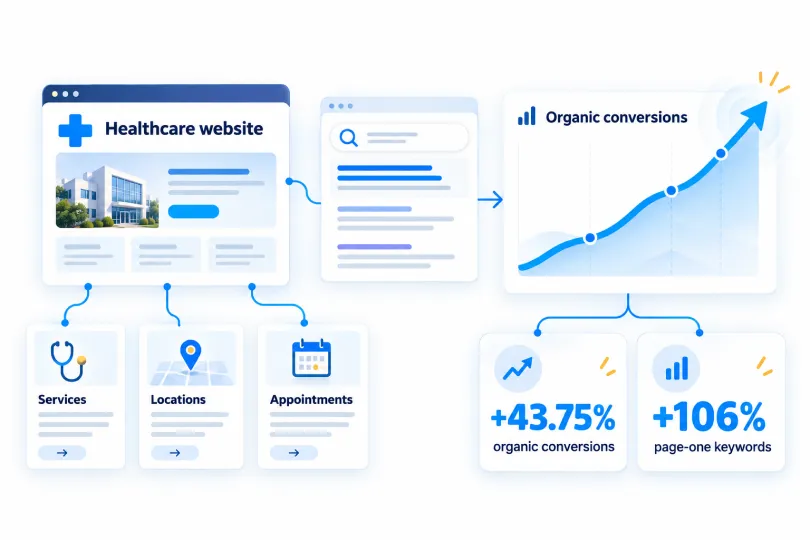
Texas Health Center for Diagnostics & Surgery: 43.75% More Organic Conversions
43.75% was the year-over-year increase in organic conversions achieved for Texas Health Center for Diagnostics & Surgery, a Plano healthcare organization serving patients across Collin, Dallas and Denton counties. During the campaign, page-one keyword visibility increased by 106%, organic clicks increased by 101.053% over six months, total organic users increased by 49.29%, and goal completions increased by 61% year over year.
The important part of that case study is not simply the percentage increase.
It is what produced it.
The campaign began with technical and structural issues, including limitations in the site’s architecture and content depth across important medical service pages. The strategy then expanded into service-page optimization, educational content and authority-focused content designed to help prospective patients understand their options before moving into a booking or treatment decision.
That is a useful model for Dallas businesses because it demonstrates why digital marketing cannot be reduced to “publishing more content.”
A medical provider needs to answer a different set of questions from a roofing company, a mortgage lender or an industrial supplier, but the underlying marketing problem is similar: customers need to find the right information, understand the company offering it and have a clear next step.
The work therefore has to connect.
Technical SEO supports discoverability. Service pages capture commercial intent. Educational content addresses research behavior. Internal linking connects informational demand to revenue-producing pages. Authority signals strengthen trust. Conversion measurement tells the team whether the increased visibility is producing the outcomes that matter.
When those parts operate together, SEO becomes much more than ranking for additional keywords.
It becomes a way of building market share in search.
Measure More Than Search Rankings
125% was the increase in organic conversions achieved for Treadstone Mortgage within six months, alongside a 327% increase in total keyword indexation and a 206% increase in top-three keywords. The campaign focused on expanding visibility across category pages, strengthening content and authority, and reversing a previous decline in rankings.
Treadstone’s campaign was not a Dallas campaign, but the principle is directly relevant to DFW companies competing in finance and other highly competitive categories.
Search growth does not happen simply because a business adds more keywords to a page. It happens when a site becomes more relevant across the range of topics and services its customers are actually researching, and when its structure gives search engines enough context to understand that expertise.
That distinction matters in a market such as Dallas-Fort Worth because competition is not limited to businesses that sell exactly the same product. Your competitors for a search impression can include national companies, directory sites, comparison sites, publishers and businesses outside your immediate geography that have built stronger authority.
A local company therefore needs to be locally relevant and digitally credible.
That is a much higher bar than having an address in Dallas.
Local SEO Is About Relevance, Not Repeating the City Name
106% more page-one keywords helped Texas Health Center for Diagnostics & Surgery expand organic visibility, but the campaign’s stated objectives also included increasing organic sessions and conversions.
That distinction is worth making because businesses often become overly focused on rankings as the primary definition of SEO success.
A ranking is only valuable to the extent that it creates an opportunity for the business.
Ranking for a query with little commercial intent may have limited value. Ranking for a service that consistently appears when prospective customers are ready to act can be considerably more important.
The same principle applies to content.
A 4,000-word article is not inherently valuable because it is 4,000 words. A page is valuable when it gives customers a useful answer, establishes the business as a credible source and contributes to the larger journey toward conversion.
That is increasingly relevant as search behavior continues to evolve.
Traditional Google results remain important, but customers can also encounter businesses through Google Maps, review platforms, social networks, video and AI-generated search experiences. The digital footprint of a business is therefore much broader than its website alone.
For Dallas companies, that means the goal should not be to optimize for one platform in isolation.
It should be to build an online presence that consistently communicates the same expertise, services, locations and brand information across the places customers are actually using to make decisions.
Digital Marketing Services in Dallas Need to Work Together
1. The Strategy Starts With the Customer Journey
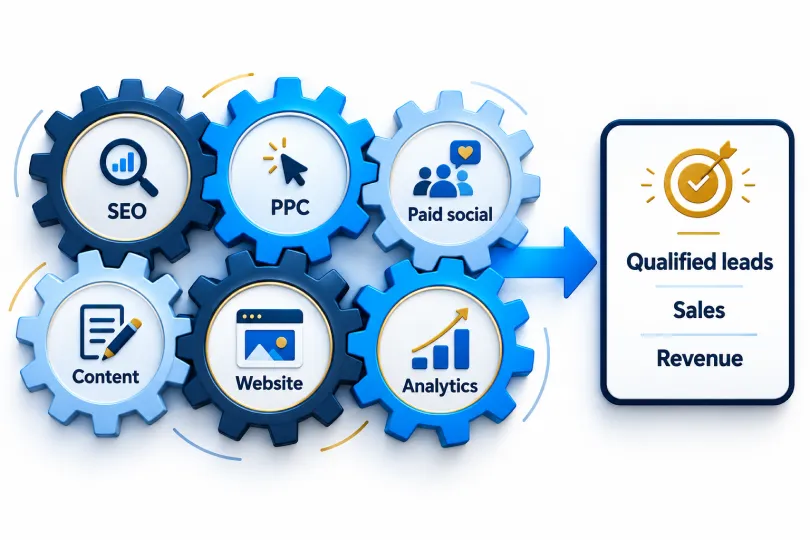
1 website is simply the place where multiple parts of the customer journey eventually meet.
This is why businesses that commission a new website and then treat the project as the completion of their marketing strategy often find themselves back in the same position twelve months later. A redesigned website can improve usability and conversion, but it cannot create demand by itself, and it cannot solve a lack of visibility, weak positioning, ineffective advertising or poor measurement.
The website has a job to do within a wider system.
Search campaigns should send people to pages that match their intent. Social campaigns should reinforce the brand and support the right stage of the buying journey. Content should answer questions that customers are actually asking. Email should help nurture demand where appropriate. Analytics should show what people do once they arrive, and CRM or sales data should help determine whether the leads being generated are valuable.
When these functions are disconnected, companies often end up optimizing individual channels while missing the larger commercial picture.
For example, an increase in organic traffic may look positive until the business discovers that much of it comes from informational searches that rarely produce customers. A PPC account may show more conversions while the sales team reports that lead quality has deteriorated. Social engagement may be increasing while website-assisted revenue remains flat.
None of those situations can be understood from a single channel report.
They require a connected view of the business.
2. PPC Management in Dallas Should Be Built Around Qualified Demand
168% was the increase in PPC conversions achieved for Specialty Equipment, alongside a 35% increase in PPC traffic. The family-owned business partnered with OMG to improve visibility around focus terms, strengthen keyword indexation and support growth across both organic and paid channels.
PPC has an obvious role in a market such as Dallas-Fort Worth because it can place a business in front of customers at the moment they are actively searching for a solution.
That does not mean every Dallas business should simply increase its Google Ads budget.
Paid search is most useful when the underlying economics make sense. If a customer is worth $8,000 over the course of a relationship, a different acquisition model may be appropriate than when the average transaction is $80. The same principle applies to lead quality, sales-cycle length, geographic coverage and how much competition exists for the relevant search terms.
A well-managed PPC strategy should therefore answer more than “how many clicks did we buy?”
It should show which searches produced qualified opportunities, which landing pages performed, which locations worked, where spend was being wasted and whether the cost of acquisition supports the value of the customers being generated.
For DFW businesses, this becomes especially important when geographic targeting is involved because the most efficient market for one company may not be the most efficient market for another. A home service company may be able to profitably expand into growing suburban areas, while a specialized B2B service may find better economics in established commercial centers with a smaller but more valuable audience.
The platform does not make that decision.
The strategy does.
3. Paid Social Needs a Defined Commercial Role Before the Campaign Begins
$199 million+ in tracked revenue is what OMG currently reports from paid social clients over the last 12 months, alongside 72 million-plus website visitors and 46 million-plus tracked conversions.
Social advertising should not be treated as an extension of organic social posting simply because both happen to appear in the same feeds.
Paid social can introduce a brand to customers who are not actively searching, build recognition among defined audiences, support remarketing and move prospects through a longer consideration cycle. For some businesses, it can be a direct-response channel. For others, it has greater value when it works alongside search, content and CRM activity.
That distinction becomes particularly useful for Dallas companies with longer buying cycles.
A prospect may not search for a commercial service every week, but they may encounter the company on LinkedIn, Instagram or Facebook months before they have an active need. When that need eventually appears, the business is no longer completely unfamiliar.
The role of social advertising therefore needs to be established before the campaign begins.
Is it generating immediate leads?
Is it building demand within a defined market?
Is it supporting another acquisition channel?
Is it retargeting people who have already demonstrated intent?
The answer affects audience strategy, creative, landing pages, campaign structure and measurement.
Without that clarity, social advertising can generate a large amount of activity without producing a clear commercial outcome.
Digital Marketing in DFW Should Focus on the Customers Worth Reaching
8.5 million residents create a large addressable market, but most Dallas businesses need only a small fraction of that audience to generate meaningful growth.
The mistake is assuming that the solution to a large market is broader targeting.
In many cases, the opposite is true.
A Dallas specialist medical provider may only need to reach patients within certain parts of the metroplex who are looking for a particular procedure. A commercial construction company may care more about a defined group of contractors, developers and property owners than it does about general consumer awareness. A high-end residential service provider may have stronger economics from fewer qualified inquiries than from a larger volume of low-intent leads.
The strategy should therefore begin with the value of the customer and the conditions that create demand, rather than starting with an arbitrary traffic target.
That affects everything from keyword selection to paid-media bidding, social targeting and creative development.
The question is not:
How many people can we reach?
The more useful question is:
Which people are worth reaching, where are they looking, and what will convince them to take the next step?
That is a much better starting point for a marketing budget.
Build Predictable Demand, Not Just Leads
1 lead is not the objective; a predictable pipeline of qualified demand is.
That difference matters because lead generation can be deceptively easy to report.
A campaign can produce 50 inquiries and still underperform if 35 are outside the service area, 10 are looking for a lower-priced service, and five are genuinely qualified. A different campaign may produce 20 inquiries and generate considerably more revenue because the audience, intent and customer value are stronger.
This is why a revenue-first digital strategy looks at the entire path from discovery to sale.
SEO identifies where organic demand exists and where competitors are capturing it.
PPC captures intent when the customer is actively looking.
Social advertising reaches defined audiences earlier in the journey and can support remarketing and demand creation.
Content answers the questions that influence consideration.
Websites and landing pages reduce friction and make the next step clear.
Analytics and attribution connect those activities to business outcomes.
None of those channels needs to operate independently.
In fact, the strongest results often come from making them work together.
Digital Marketing Audit for Dallas Businesses: 6 Questions to Ask
6 questions can expose most of the strategic problems that sit underneath underperforming digital marketing.
1. Where is the revenue coming from now?
Before changing channels, a business should understand which customers, services and locations are already producing revenue and how those customers are finding the company.
That baseline prevents the common mistake of investing heavily in a channel simply because it is fashionable or because a competitor appears to be using it.
2. Where is demand growing across DFW?
In DFW, this question has a geographic component that should not be ignored.
Population growth is occurring well beyond Dallas proper, with outer-ring communities such as Celina, Princeton, Melissa, Anna and Forney among the fastest-growing places in the region.
For a service-area business, that can affect which locations deserve attention first. For a B2B company, the more relevant signal may be where commercial activity is expanding.
3. What are Dallas customers searching for before they become customers?
The obvious service keyword is rarely the entire customer journey.
Customers search for symptoms, comparisons, costs, alternatives, brands, reviews, locations and questions before they commit. A business that understands that research behavior can build content and landing pages that establish relevance before the customer reaches the final purchase stage.
4. Where does the website lose commercial intent?efore they become customers?
A strong traffic number does not help much when high-intent visitors cannot find the relevant service, understand the offer or determine what to do next.
Conversion analysis should therefore sit alongside SEO and paid-media reporting rather than being treated as a separate website project.
5. Are paid channels producing profitable demand?
The answer should be based on lead quality and customer economics, not simply conversion volume.
This is particularly important for industries with large differences between average order values or substantial sales involvement after the lead is generated.
6. What should change next month?
A good strategy is not static.
Search demand changes. Competitors change. Markets expand. Platforms change. Customer behavior changes. Performance data changes.
The agency-client relationship should therefore be built around ongoing learning rather than a fixed list of deliverables that looks identical every month.
Choosing a Dallas Digital Marketing Agency Means Looking Beyond the Service List
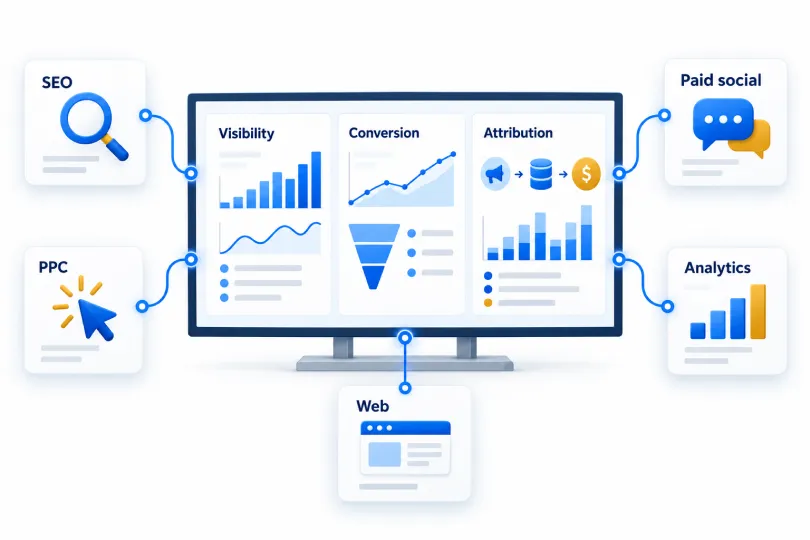
200+ specialists are part of OMG’s broader team, with the US operation based in Dallas since 2019. OMG’s current model is built around specialist disciplines across SEO, PPC, paid social, web, analytics and AI search rather than expecting one generalist to manage every part of the account.
That structure matters because digital marketing has become too complex for a single channel or generalist viewpoint to catch every meaningful opportunity.
An SEO specialist sees technical and search-demand patterns that may not be obvious from a PPC dashboard. A paid-media specialist understands auction dynamics, budget allocation and conversion economics at a different level. A social specialist can identify creative and audience signals that would be invisible in an organic search report. Analytics connects those disciplines to actual business performance.
The value is not having more people for the sake of having more people.
The value is having specialists who can go deeper into the numbers and then connect those findings into one commercial strategy.
That is particularly useful for Dallas businesses that have already reached the point where marketing is too important to manage through disconnected freelancers, isolated channel vendors or monthly reporting that does not answer the underlying business questions.
Next steps
Dark Social is just one avenue to explore as you build a digital presence that drives results, A.K.A. more customers and boosted revenue. Is your online digital marketing efforts going the mile? Cataloguing the quick wins and mapping the long term goals begins with an audit.
The Dallas Digital Marketing Opportunity Is Bigger Than More Traffic
1 strategy that connects SEO, PPC, social, content, website performance and analytics is generally more useful than six disconnected marketing activities.
The DFW market is already crowded with companies publishing content, running ads and competing for the same search results.
Winning that environment does not necessarily require more activity.
It requires better decisions.
That means identifying where demand exists, understanding where competitors are taking market share, building the right pages for the right customers, paying for traffic where the economics work, using social advertising with a defined commercial role and measuring what happens after the click.
The businesses that do this well tend to have something in common: their marketing decisions are tied to the economics of the business.
They know what a customer is worth.
They know what a qualified lead is worth.
They understand which locations matter.
They know where their website performs and where it creates friction.
They can identify which channels create demand and which channels capture it.
Most importantly, they know what they are changing and why.
Start With the Business, Not the Channel
1 of the biggest strategic mistakes a business can make is choosing the marketing service before defining the commercial problem.
A company that needs more qualified demand may require a different solution from a company that has plenty of traffic but poor conversion rates. A business entering a new DFW suburb may need a different strategy from one defending an established position in Dallas. A B2B company with a long sales cycle may need a different channel mix from a high-volume local service company.
There is no benefit in running PPC simply because competitors are running PPC, publishing weekly blogs simply because a content calendar says so, or increasing social spend because engagement has become a reporting objective.
The channel should follow the problem.
The strategy should follow the economics.
The measurement should follow the outcome.
That is the standard a Dallas business should expect from its digital marketing partner.
Growth Is a Long-Term Market Share Play
8.5 million people create a significant market opportunity, but only the businesses that become visible and credible at the right moments can capture it. DFW’s continued growth, particularly across its outer suburbs and employment centers, means the market is expanding in ways that change where businesses should compete for attention.
The answer is not simply more advertising.
It is a digital presence built around the way customers actually make decisions.
That means showing up where demand exists, whether that is Google Search, Maps, social media, paid campaigns, organic content or AI-driven discovery. It means having service pages that answer commercial questions, location pages that provide genuine local value and content that demonstrates expertise rather than simply filling a publishing schedule.
It also means knowing which activity leads to revenue and which activity only looks good in a report.
That is the difference between having a marketing presence and building a digital growth engine.
Build a Dallas Digital Marketing Strategy Around the Numbers That Matter
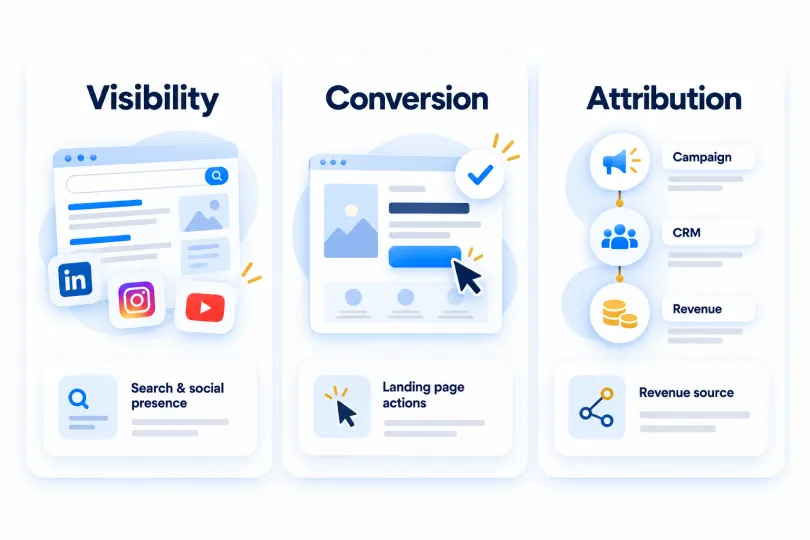
3 areas deserve attention before a business increases its marketing budget: visibility, conversion and attribution.
First, understand where the company currently appears across organic search, local search, paid search and paid social, and compare that visibility against the locations, services and audiences that matter most to revenue.
Second, review what happens after the customer arrives, because even a well-targeted campaign can underperform when the landing page is difficult to navigate, the offer is unclear, trust signals are weak or the next step is not obvious.
Third, connect campaign data to actual business outcomes so that marketing decisions can be based on qualified leads, customers and revenue rather than traffic and engagement in isolation.
That assessment should produce a prioritized plan rather than another generic list of recommendations.
For some businesses, the immediate opportunity will be technical SEO or local visibility. For others, it may be paid search structure, landing-page performance, social advertising, content depth, analytics or a combination of several of those areas.
The important part is knowing why.
FAQs on Digital Marketing in Dallas-Fort Worth
A Dallas digital marketing strategy should connect SEO, paid search, paid social, content, local visibility, AI search and conversion optimization to one commercial objective, and measure the result in qualified leads, sales and revenue. The mix depends on the business. A B2B company with a long sales cycle needs a different channel sequence from a high-volume home services company. Start with where revenue already comes from, where demand is growing across DFW and what a qualified customer is worth, then choose channels that follow that evidence rather than a generic service list.
No. Dallas-Fort Worth is an 11-county metropolitan area with very different growth rates, industries and customer behavior from one part of the metroplex to another. Growth since 2020 has concentrated in outer suburbs such as Celina, Princeton, Melissa, Anna and Forney, while Fort Worth has its own employment profile built on trade, transportation, manufacturing and aerospace. A campaign that ranks or converts well in Dallas can still be invisible in Fort Worth or the northern suburbs. Local strategy should follow where demand is moving, not simply where the business is headquartered.
Start with the channel that matches the commercial problem, not the one a competitor happens to be using. PPC captures demand immediately when the customer is actively searching and the acquisition economics make sense, so it suits businesses that need qualified inquiries now. SEO builds market share in search over time and compounds when technical work, service pages, content and conversion measurement operate together. Most DFW businesses eventually need both, sequenced around customer value, sales cycle and how much wasted spend or conversion friction already exists.
Measure success in qualified leads, customers and revenue, with traffic, rankings and engagement treated as supporting signals. A campaign can produce 50 inquiries and underperform if 35 sit outside the service area and only five are qualified. Connect analytics to CRM or sales data so each channel can be judged on lead quality and customer value, then review attribution so demand-creating channels such as paid social are not undervalued because search recorded the final click.
It depends on the business model, but the Census data points to the outer ring. Celina grew 276.8% between 2020 and 2025, Princeton grew 156.1%, and Melissa, Anna and Forney are among the fastest-growing places in the region. A service-area business should prioritize growth corridors it can serve profitably. A multi-location company needs useful location pages for each market. A B2B company may care less about suburbs and more about the industries, business districts and decision-makers that create the highest-value demand.
Because digital marketing has become too complex for one generalist to catch every opportunity. An SEO specialist sees technical and demand patterns a PPC dashboard hides, a paid media specialist understands auction dynamics and conversion economics, a social specialist reads creative and audience signals, and analytics connects all of it to business performance. OMG’s US operation has been based in Dallas since 2019 and draws on a broader team of 200+ specialists across SEO, PPC, paid social, web, analytics and AI search, working to one commercial strategy rather than a set of disconnected channel reports.
Work With a Dallas Digital Marketing Agency That Understands DFW
2019 was the year OMG established its US presence in Dallas, and the business continues to position the Dallas operation around growth across Texas as well as national markets.
OMG’s current service model brings SEO, PPC, paid social, web, analytics and AI search into one broader digital strategy, with case studies tied to named clients, timeframes and measurable outcomes.
For a Dallas-Fort Worth business, that combination matters because growth rarely happens through one isolated channel.
Search visibility affects paid-media economics. Paid campaigns create data about demand. Social advertising reinforces awareness. Content supports both search and consideration. Website performance affects every channel that sends traffic. Analytics determines whether the entire system is producing commercially useful results.
The market is large, but it is not homogeneous. It is growing, but that growth is not evenly distributed. Competition is substantial, but so is the opportunity for businesses that understand where their customers are, what those customers are searching for and what it takes to turn that attention into revenue.
The strongest digital marketing strategy is therefore not the one that promises the most activity.
It is the one that can explain, in plain English and with numbers, where the opportunity is, what needs to change and how the work will be measured.
That is the standard OMG brings to Dallas businesses: specialist digital marketing built around visibility, qualified demand, conversion and measurable commercial performance. If you want a plain-English read on where your Dallas-Fort Worth business is visible, where it is losing commercial intent and what should change first, book a free strategy session with OMG’s Dallas team. You leave with a prioritized plan, not a generic list of recommendations.

About the author
Read More Blogs
-
27 minutes read
Digital Marketing in Dallas-Fort Worth: How Local Businesses Can Turn Market Growth Into Measurable Revenue

Last updated on:
-

Last updated on:
-
 12 minutes read
The PPC Audit Checklist We Run Before Every US Pitch
Last updated on:

Stop Guessing What Your Marketing Should Do Next.
Your free $4,000 strategy session shows where your digital marketing is leaking performance across search, paid media, content and conversion. You leave knowing what to fix first and what a stronger strategy could produce.