Everything Is Bigger in Texas, And That MeansExposure, Opportunities and Revenue


Last updated:
|
19 minutes readIt’s September in Texas, which means the countdown has started: the Texas State Fair opens its gates in Dallas in three weeks, and Q4 is right behind it. Media costs are about to climb, marketing teams are closing one budget year while trying to justify the next, and businesses across the state are staring at the same enormous market and asking the same question — how do we get more of it?
Texas’ economy reached an estimated $2.9 trillion in 2025, making it the eighth-largest economy in the world if it were a country, roughly 9.4% of U.S. GDP, with 57 Fortune 500 companies calling the state home.
Every business operating in Texas receives the same economic tailwind, and when demand rises, more businesses show up in hopes of capturing it. The real market advantage is being found, especially now that 68.01% of U.S. Google searches end without a click, and Q4 is all about peak sales and revenue, year-end financial reviews and strategic planning for next year.
Key Takeaways
- Texas' $2.9 trillion economy creates enormous opportunity, but market size alone does not give a business a competitive moat.
- Search is increasingly about being present in the answer, not simply ranking for a keyword: 68.01% of U.S. Google searches ended without a click in the first four months of 2026.
- The 24-day State Fair of Texas creates a measurable demand wave across North Texas that matters far beyond the businesses operating inside Fair Park.
- Texas continues to attract companies, workers and investment, which means the competitive landscape is changing as fast as the market itself.
- Texas has a public, substantial economic-development incentive system that can create opportunities for both businesses seeking support and B2B companies selling into growing industries.
- Q4 is when businesses need demand most and often when buying attention gets more expensive, making visibility built before October significantly more valuable.
- The smartest 2027 marketing budgets won't simply spend more. They'll invest in becoming easier to find, easier to trust and easier to choose.
The Texas Number Everyone Quotes, And the One That Actually Matters
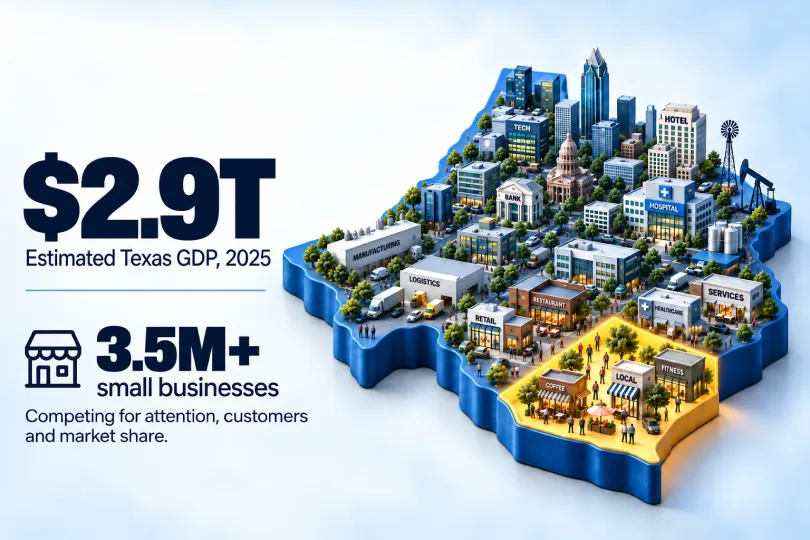
Texas produced an estimated $2.9 trillion in GDP in 2025, with real economic growth of 2.5%, which makes it the eighth-largest economy in the world when compared against national economies, a huge number that’s surprisingly very easy to misunderstand because a $2.9 trillion economy doesn’t mean your business gets a $2.9 trillion opportunity. Your opportunity lays in a slice of said market where your customers exist, search, compare and actually buy. That slice is crowded: Texas has more than 3.5 million small businesses, representing 99.8% of all businesses in the state, millions of businesses all competing for the same attention, customers and market share.
Being found while operating in a Texas’ sized market is the game.
A decade ago the most basic digital marketing question was straightforward: can customers find you on Google? That was it. Now in today’s day and age it’s really about: can they find you on Google? Maps? Are you showing up in AI-generated results? What do your social platforms look like? And once you’re seen, do they have a reason to choose you over your competiiton?
Exposure, The Difference Between Being Seen and Being Found
1. Impressions Got Cheap. Being Chosen Got Expensive.
For a long time, digital marketing reporting rewarded raw visibility, more impressions, more reach, more traffic, more views. Unfortunately, those numbers aren’t enough anymore.
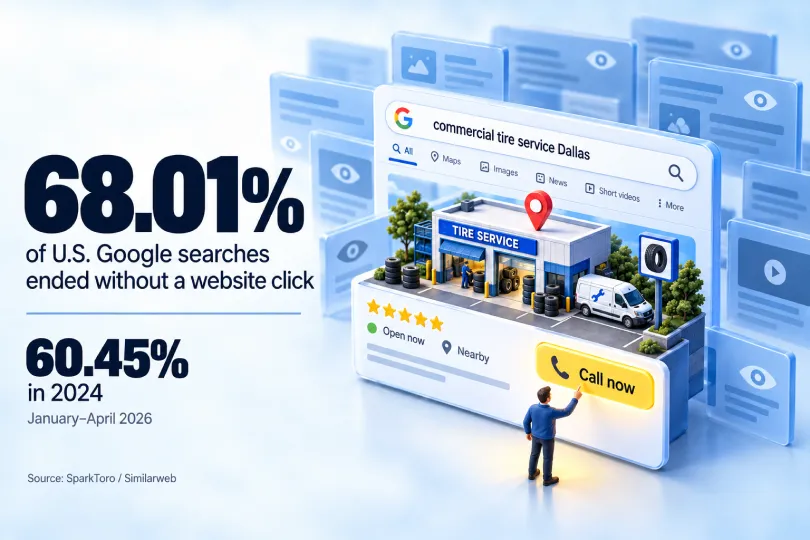
In the first four months of 2026, 68.01% of U.S. Google searches ended without a click to another website, up from 60.45% in 2024, according to SparkToro’s analysis of Similarweb clickstream data. AI Overviews were showing up on more than 20% of searches over the same period, and SparkToro found their presence could cut click-through rates by roughly 60%. Simply put: a business can be visible without getting “a click”, a brand can rank without getting the customer, and a report can show impressive exposure while the actual commercial action is happening somewhere else entirely.
What we’ve known to make a business ‘visible’ has completely changed. What matters now is whether a business is present the moment intent happens. Someone searching “urgent care near me” doesn’t care how many impressions a healthcare provider generated last month, they want the closest credible option and fast. Someone searching “commercial tire service Dallas” wants availability, location, reviews and a phone number, not a beautifully designed impressions report. One gets the attention while the other has a much better shot at actually getting the business.
2. The 24 Days That Reset Search Demand Across North Texas
On September 25, the Texas State Fair opens in Fair Park and runs for 24 consecutive days through October 18, 2026, the longest-running fair in the nation — with major draws on the calendar like the State Fair Classic and the Texas vs. OU Red River Showdown on October 10. What matters for most DFW businesses isn’t Bevo, though. It’s the demand signal underneath the event: the Fair generated an estimated $562.3 million to $680.3 million in economic impact for North Texas in 2023, attributed to 4,486 jobs and $70.5 million in federal, state and local tax impact, and more than two million people attended in 2025.
Think about what two million people moving through just one metro area over a span of 24 days actually generates. Searches, and a lot of them and most have nothing to do with parking or concession stands. People need hotels, gas, transportation, roadside assistance, urgent care, dentists, HVAC, locksmiths, childcare, security, staffing, logistics, insurance and waste management, and the businesses behind those businesses need something too. That doesn’t mean every Texas company needs a State Fair campaign; it means the Fair is a useful, published example of something marketers often overlook — large events create temporary but predictable demand conditions that extend well beyond the event itself. The dates are known, the location is fixed, the audience is measurable, and the surrounding economic activity is real, which is about as clean a piece of marketing information as you’re going to get for free. You can’t ask for better free marketing data than that.
2026 adds a wrinkle worth watching. The 2025 Fair drew 2,020,064 visitors, its lowest attendance since 2018, so the Fair lowered admission prices for 2026, adult weekday tickets from $19 to $15, weekend tickets from $29 to $25 — which makes this year less a repeat of last year and more of a volume-recovery play. If lower prices bring people back, more people moving through the city means more potential demand, and businesses that had already built visibility before September 25 will have a much better shot at capturing it than the ones who wait until October 1 to decide they should “do some marketing.” That’s less a Fair-specific tactic than a general rule about demand generation: the market tells you when people are coming, and it’s your job to make sure they can find you when they do.
3. We Didn’t Choose Texas. Texas Chose Us.
Texas isn’t just growing organically, companies, people and capital are all actively relocating here. CBRE found that Dallas-Fort Worth led U.S. metro areas for headquarters relocation announcements in 2025, with 18 announced moves, eleven of them interstate or international. The population story tracks right alongside it: the Dallas-Fort Worth-Arlington metro added 123,557 residents between July 2024 and July 2025, reaching an estimated 8.48 million people, making that roughly 339 new residents every single day.
New residents almost always never arrive with a directory of local businesses already picked out, they have to search for their first HVAC company, dentist, accountant, restaurant, mechanic and commercial supplier, all over again, as if none of your own history in the market existed. That’s an opportunity for businesses with strong local visibility and a real threat to the ones coasting on “we’ve always been here,” because the person who just moved from Chicago has no idea you’ve operated in Dallas for 15+ years. Google seriously doesn’t care how long you’ve been around, either, the customer still has to find you, and your competitive set is quietly changing while you’re reading this. The company that relocated brought employees, suppliers, customers and purchasing needs along with it, so the market got bigger and the fight for growth also got bigger. That’s how OMG made it way here.
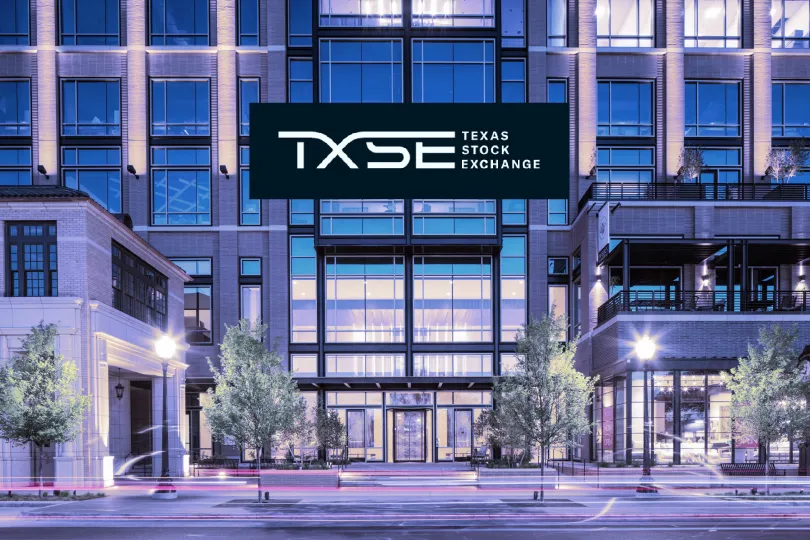
What The Texas Stock Exchange Actually Means For Texas Businesses
4. The Incentive Stack Is Public, Real and Very Under-Used
Texas doesn’t hide its economic-development programs. The state runs a broad portfolio of incentives that is meant to attract investment, create jobs, encourage expansion and support business development, including the Texas Enterprise Fund and the Texas Jobs, Energy, Technology and Innovation program (JETI). The Enterprise Fund offers performance-based grants to companies weighing a Texas project against an out-of-state alternative; JETI backs qualifying large-scale, capital-intensive projects, including a 10-year school district maintenance-and-operations tax appraised-value limitation of 50%, subject to program requirements. Add in the fact that Texas has no corporate income tax and no personal state income tax: You get a state that has clearly built a system designed to keep real money, capital investment, hiring and expansion constantly flowing.
That matters to marketers because economic activity is commercial opportunity in disguise: a funded company may need employees, an expanding one may need software, a manufacturer adding capacity may need new suppliers, and a relocated headquarters may need legal, financial, logistics, commercial real estate or technology services. You don’t need to become a tax expert. You just need to know where the money’s moving.
5. The 2026 R&D Change More Texas Businesses Should Have on Their Radar
Texas also changed its research and development franchise tax credit through Senate Bill 2206, making the credit permanent for eligible businesses and raising the rate to 8.722% under the standard calculation (10.903% in qualifying higher-education research circumstances). There are qualifying rules, obviously, and this isn’t tax advice, the marketing question worth asking is what happens when businesses suddenly have more room to invest. An R&D-heavy manufacturer, tech company or research organization isn’t just a potential tax-credit claimant; it’s a potential buyer, and more investment on their end can mean new equipment, software, hires, vendors and marketing needs on yours.
The strongest B2B marketers know how to connect signals like this to an actual commercial intent. An incentive announcement isn’t automatically a lead, but it can tell you where future demand is headed, worth knowing before the competition figures it out too.
6. Growth Is Forecast, Not Hoped For
The Dallas Fed’s 2026 Texas Employment Forecast projects 1.7% employment growth, with an 80% confidence range of 1.3% to 2.1%, healthy numbers, but the kind that create a dangerous marketing illusion. Growth markets can make mediocre marketing look good: customers keep coming in, demand keeps rising, revenue keeps moving, and everyone feels successful, right up until the market cools and businesses find out whether their marketing built durable demand or just rode the tide.
Strong organic visibility doesn’t get less valuable as the market grows; if anything, it gets more valuable once growth slows down a bit, and the same is true of local authority, reviews, conversion optimization, customer data and brand demand. Build those while the market is moving in your favor, not after you’re already scrambling for them.
What We’re Seeing In DFW Search Demand
7. What Texas Businesses Actually Produce
Texas represents roughly 9.4% of U.S. GDP and 20% of U.S. exports, with approximately $450.3 billion in goods exports in 2025, huge numbers, but they don’t come only from Fortune 500 headquarters and multinationals. They come from the 3.5 million small businesses employing 5.1 million Texans: contractors, manufacturers, restaurants, health providers, professional service firms, retailers, transportation companies, and thousands of others most people will never see on a national ranking.
All of them are competing for the same thing, attention from people ready to buy, which is why digital marketing works differently for a small business than a big one. You don’t need to out-scale your competitor. You have to be easier to find in the moment the customer is actually needing you.
8. Your Best Quarter Is Also Your Most Expensive One
This is where the timing gets uncomfortable: the State Fair begins September 25, Q4 follows immediately, holiday commerce accelerates, advertisers compete harder for the same attention, and most marketing teams are already working with tighter budgets than they’d like. Gartner’s 2026 CMO Spend Survey found that marketing budgets average just 7.8% of company revenue, down 18% from four years earlier, and 56% of CMOs said they didn’t have enough budget to deliver their 2026 strategy at all. Businesses are essentially being asked to produce more with less room to do it, which is exactly the environment where channel strategy stops being optional.
The mistake most companies make is waiting until October to decide they need visibility, by then, everyone else has had the same idea, and the cost of buying attention has already climbed. Organic search doesn’t charge a Q4 premium because holiday campaigns are live, a useful service page doesn’t get more expensive to rank because Black Friday is approaching, and a Google Business Profile doesn’t bid against the company down the street. The catch is that building that kind of visibility takes time, so while the inventory itself may be free, the preparation for it isn’t.
None of this means paid media stops mattering, it just shouldn’t have to carry the entire quarter on its own. Use paid channels to capture incremental demand, accelerate reach and test what’s working, but then use the organic search, local visibility and useful content to build the kind of asset you don’t have to keep re-buying every time somebody searches. You can’t buy being found in Q4 at Q2 prices, you can only build it ahead of time, before you actually need it.
9. 2027: The Number to Budget Against
Texas is still expanding: the Texas Comptroller’s 2026–27 revenue estimate projects gross state product at roughly $3.064 trillion in 2027, about $160 billion more than the $2.9 trillion figure from 2025. Your business doesn’t get a percentage of that automatically, though, and neither does ours, which is why the right 2027 budget question isn’t “how much should we spend because Texas is growing,” but “how much demand relevant to our business actually exists, and what will it take to consistently capture it.” That’s a far more useful budgeting conversation to have.
What This Means for Your Marketing Budget, Starting This Week
You don’t need another broad directive to “increase marketing investment”, you need an actual calendar.
Before September 25: Build the foundation. Audit the pages driving your highest-value traffic, update local content, strengthen your Google Business Profile, and make sure service areas, contact information and conversion paths are all accurate. Publish the content customers are likely to need in October, and refresh the pages that are already ranking but could be doing more. This is also the point to start measuring beyond impressions, track non-branded qualified leads, Google Business Profile calls and direction requests, qualified organic conversions, brand versus non-brand demand, and AI visibility wherever it’s measurable. That’s why we knew Gurulytics needed to exist.
September 25 through October 18: Watch instead of guessing. Pay attention to which searches increase, which locations perform, and which services suddenly become more valuable, and check whether calls start mentioning the Fair, events, traffic or travel. This is a known, dated event, which makes it a rare chance to treat analytics as an actual testing ground instead of a monthly reporting ritual.
October 19 through December 31: This is where you find out what the Fair period actually taught you. Look at what created revenue, which searches converted, which pages produced qualified leads, and which paid campaigns brought in incremental customers rather than ‘customers who were coming anyway’. Take those specific findings, not generic instincts about needing “more SEO” or “more social”, into the 2027 budget conversation. That’s the difference between a marketing budget and an actual growth plan.
The Mistakes We See in Texas Accounts
Treating Texas like one market. Texas is a state, not a single customer, DFW, Houston, Austin, San Antonio and El Paso are all genuinely different markets with different buying behavior, and treating them as one blurs everything from keyword strategy to ad targeting. The strongest campaigns get specific about where demand actually lives and how customers in each of those markets search.
Assuming the Fair only matters if you sell at the Fair. The State Fair isn’t a 24-day advertising brief so much as a measurable demand event, and the two call for different responses. Skip copying somebody else’s Fair campaign, instead, look at your own customers and ask how their behavior might actually shift during those 24 days.
Treating English-only marketing as the default. The Fair’s own 2026 audience materials report that 36% of attendees are Hispanic, with 26.1% coming from Spanish-speaking households, for many Texas businesses, that’s already core market, not a niche audience to get around to translating for eventually. Your language strategy should reflect your customers, not just whatever language your marketing team happens to speak in the office.
Switching on paid media in October and calling it a Q4 strategy. That’s not a strategy, it’s a deadline dressed up as one. Paid media absolutely has a place in a Q4 plan, but starting from zero once competition is already at its peak is an expensive way to discover that your customers do exist, you just haven’t met them.
Bidding on your own brand and calling it growth. Branded search matters, but it measures something different from non-branded acquisition. If someone’s already searching your company name, the job isn’t convincing them your business exists, it’s figuring out how much of that demand you actually created vs how much was already headed your way, so you’re not congratulating yourself for catching customers who were coming regardless.
Confusing a massive TAM with a winnable market. Texas has a huge total addressable market. Your business probably doesn’t, and that’s fine, what you actually need might be homeowners in one DFW service area, fleet managers within 50 miles of your facility, or manufacturers in three specific metros if you sell B2B software. Get specific. A smaller market you can dominate is worth far more than a massive one nobody can find you in.
How OMG Approaches Texas Growth
We’ve been in Dallas since 2019, so when a business comes to us ready for growth, we’re not starting with a blank piece of paper. We’ve seen what happens when businesses scale into the wrong places, rank for the wrong keywords, generate leads they can’t close, and celebrate attribution that never actually proved incremental growth, and we’ve seen the opposite too, when the fundamentals line up: strong demand, clear positioning, useful content, real measurement, a local presence customers trust, paid media with an actual job to do, and organic visibility that keeps compounding long after the campaign ends.
That’s how we look at Texas, a market full of demand that has to be understood, reached and converted. There’s a real difference between saying “Texas is growing” and being able to say “our business is capturing more of that growth.”
FAQs About the Texas Stock Exchange
It runs September 25 through October 18 at Fair Park in Dallas, 24 consecutive days that generated an estimated $562.3 million to $680.3 million in economic impact back in 2023, with more than two million attendees in 2025. None of that requires you to have a Fair booth to matter to your business: large events change how people move through a metro area and what they need while they’re in it, so depending on your industry you could see more demand for transportation, hotels, automotive services, healthcare, food, staffing, security, logistics or professional services. The point isn’t to sell at the Fair, it’s to notice what shifts in the market when an event this size shows up.
Start before September 25, review the local pages customers rely on most, keep your Google Business Profile accurate, build up reviews and local authority, and publish useful content around whatever services people are likely to need during the event. Then, once the Fair is running, pay attention to what actually happens: which searches pick up, which locations perform, which services start generating more calls. None of this is about building a gimmicky “Fair campaign”, it’s about being ready for demand you already know is coming.
Yes, by most measures, the state has more than 3.5 million small businesses, 57 Fortune 500 headquarters, and a population growing fast enough that DFW alone added more than 123,000 residents between July 2024 and July 2025. But “is Texas competitive” is honestly the less useful question. What matters more is whether your business can become relevant and visible to the specific customers you actually want, because the right positioning tends to matter more than the raw amount of competition.
Q4 concentrates advertiser demand around major commercial and holiday periods, so more businesses end up bidding on the same audiences, placements and attention right as budgets are already tight, Gartner found 56% of CMOs in its 2026 survey said they didn’t have enough budget to execute their strategy at all. Spending more isn’t always the answer. Building organic, local and AI-search visibility before Q4 gets there, then using paid media specifically for incremental reach or high-intent demand and measuring what actually drives revenue, takes a lot of the pressure off paid media to carry the whole quarter by itself.
There’s no single useful number here, it should come from your revenue goals, average customer value, acquisition costs, current market position and how much realistic demand you can actually capture. Texas’ economy is projected to hit roughly $3.064 trillion in 2027, but you’re not competing for the entire Texas economy. You’re competing for your customers, specifically, so that’s where the budget conversation should start.
Being seen means someone was exposed to your brand at some point. Being found means your business showed up when someone was actively looking for a solution, a meaningfully different thing, especially with 68.01% of U.S. Google searches ending without a click in early 2026. Driving people to a website is no longer the whole story; customers might discover you through search results, Maps, AI-generated answers, reviews or somewhere else in the ecosystem entirely. The goal is to own more of those moments, not just accumulate more impressions.
Final Strategic Takeaway
Everything is bigger in Texas. The economy is bigger. The population is bigger. The opportunity is bigger. The competition is bigger. And, come Q4, the cost of being invisible gets bigger too. The State Fair of Texas gives us a useful example because it puts the principle on a calendar. Demand increases. People move. Searches change. Budgets tighten. Competition rises. The businesses that benefit most aren’t necessarily the ones that shout the loudest once the Fair starts. They’re the ones customers were able to find the easiest. That is the opportunity in Texas right now. Not just to be simply visible, but to be the answer.
Ready to find where your next growth opportunity is hiding? Book A Free Strategy Call with OMG.

About the author
Read More Blogs
-


Last updated on:
-
 12 minutes read
The PPC Audit Checklist We Run Before Every US Pitch
Last updated on:
-
10 minutes read
Engineering For Google AI Mode: How To Win Citations In Query Fan-Out & Deep Search Retrieval
Last updated on:


Stop Guessing What Your Marketing Should Do Next.
Your free $4,000 strategy session shows where your digital marketing is leaking performance across search, paid media, content and conversion. You leave knowing what to fix first and what a stronger strategy could produce.