

The Texas Stock Exchange Is Trading: What It Means For Every Texas Business

Last updated:
|
11 minutes readOn July 10, 2026, the Texas Stock Exchange began live trading from Dallas, progressing from test symbols to real securities. But your company does not need an IPO plan for that to matter.
Is the New York Stock Exchange moving to Texas? No, NYSE Texas launched in 2025 as a fully electronic equities exchange based in Dallas. It’s a distinct NYSE Group market, not a relocation of the flagship exchange.
A new exchange attracts corporate attention and investment into an already competitive market. The immediate question for most owners is not, “Can we list?” But, “What happens when more ambitious companies and better-funded competitors move closer?”
Key Takeaways
- The Texas Stock Exchange, officially abbreviated as TXSE, is now trading securities. Corporate listings are expected to follow later in 2026.
- The New York Stock Exchange is not moving to Texas. NYSE Texas is a separate Dallas-based exchange within NYSE Group.
- Private mid-market firms will feel the effect indirectly through deeper financial infrastructure, greater corporate activity, and increased competition.
- Dallas is gaining weight as a financial center, but that also means a tighter market for experienced talent.
- More investment and business formation create more demand. They also create more noise, making customer attention increasingly expensive to win.
What Is The Point Of The Texas Stock Exchange?
The Texas Stock Exchange exists to increase competition within US public markets. It offers another national venue for trading securities and, later, listing public companies and exchange-traded products. Its stated aim is to give issuers and investors greater choice, transparency, and alignment while addressing the cost of entering and remaining in public markets.
The TXSE received SEC approval on September 30, 2025, and began production trading in July 2026. Its phased rollout started with a small group of securities before expanding more broadly.
It goes without saying that trading is only the first chapter. TXSE anticipates launching exchange-traded product listings in September 2026 and its first corporate listings in October 2026, although those dates remain subject to change. Furthermore, the exchange is not reserved for companies founded in Texas. It’s designed as a national market for US and international issuers. Dallas is the base, not the boundary.
Who Is Behind It?

TXSE was founded by James H. Lee, who serves as chairman and CEO of both the exchange and its parent, TXSE Group. The leadership and governance teams include executives with experience across exchanges, investment management, liquidity provision, regulation, energy, banking, and public companies.
That said, the investor list is where the project moves firmly beyond a promising Dallas business news headline.
According to TXSE’s official financing announcement, J.P. Morgan joined major institutional investors, including BlackRock, Charles Schwab, and Citadel Securities. TXSE Group reported more than $250 million in total capital raised and said 82 financial institutions and business leaders held equity in the company.
Earlier disclosed backers included Dell Family Office Management, Fortress, Jump Trading, Squarepoint, Susquehanna Private Equity Investments, and Tower Research.
While backing doesn’t guarantee TXSE will capture a particular share of US trading or listings, it does show that the exchange has serious capital, market infrastructure expertise, and relationships behind it. This isn’t a regional novelty wearing a financial-services badge.
Is The New York Stock Exchange Moving To Texas?
No. The New York Stock Exchange is not moving from New York to Texas.
The confusion comes from the launch of NYSE Texas, a separate, fully electronic exchange headquartered in Dallas. Intercontinental Exchange, the parent of the NYSE, created it by reincorporating and renaming NYSE Chicago. NYSE Texas opened for business in March 2025. The flagship New York Stock Exchange remains in New York.
TXSE and NYSE Texas are different organizations:
| Exchange | What It Is | Dallas Connection |
| Texas Stock Exchange | Independent national exchange | Built and headquartered in Dallas |
| NYSE Texas | Part of NYSE Group | Electronic exchange based in Dallas |
| New York Stock Exchange | NYSE Group’s flagship exchange | Remains based in New York |
NYSE Texas primarily provides companies with another listing and trading venue, including dual-listing opportunities for qualifying issuers. It operates on NYSE technology and sits within the wider NYSE market structure. New exchange infrastructure is being established in Dallas, but Wall Street has not packed its boxes.
What The Texas Stock Exchange Actually Means For Texas Businesses
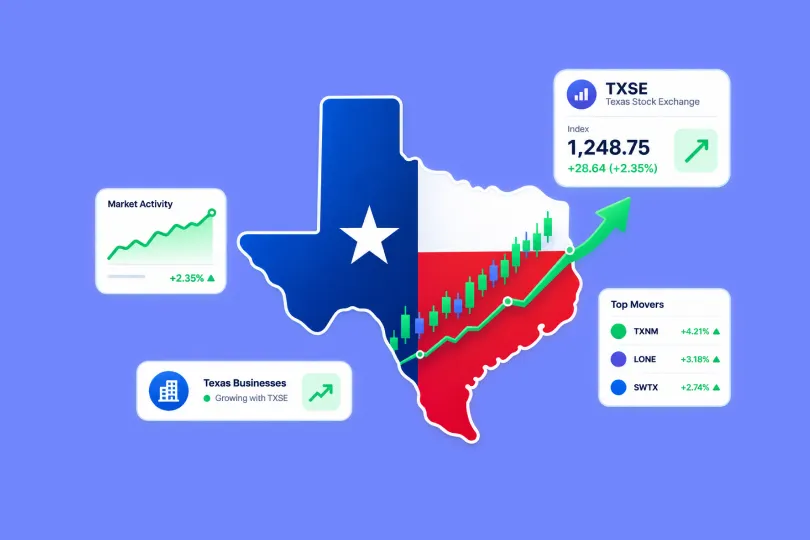
For most business owners, the important story is not which securities are traded on launch day. It’s what happens around an exchange once capital, advisers, employers, and ambitious companies begin gathering around it.
1. Capital Access Moves Closer, But It Doesn’t Become Automatic
A local stock exchange does not write checks to private businesses. A $5 million manufacturer or $20 million technology firm will not suddenly qualify for public capital because its headquarters share an area code with TXSE. The more realistic benefit is ecosystem depth.
As Dallas attracts exchange operators, investment banks, securities lawyers, accountants, compliance specialists, investor-relations professionals, and institutional capital, mid-market firms gain closer access to people who understand complex funding and ownership options.
That may support better conversations around private equity, debt, strategic investment, acquisitions, and eventual public-market readiness. It may also give larger Texas companies another listing option once TXSE’s corporate listing program begins.
The exchange also drastically shortens the distance to expertise, but we don’t think it removes the governance, scale, disclosure, or financial discipline required to raise serious capital.
2. Dallas Gains More Weight As a Financial Center
TXSE did not create Dallas’s finance sector. Rather, we believe it arrived because that sector was already gathering momentum.
The Dallas Fed describes Dallas-Plano-Irving as Texas’s business and financial-services hub, and the scale of recent investment supports the label. Major institutions are committing thousands of jobs, purpose-built campuses, and long-term expansion plans.
Goldman Sachs, for example, is building a campus designed to house 5,000 employees as of this writing. Charles Schwab had 7,000 workers in the area at the end of 2024 and has discussed plans to reach 10,000. Fidelity employs about 5,000 people locally, while Wells Fargo opened an Irving campus built for 4,500 employees.
TXSE adds market infrastructure to that concentration. It gives financial firms, public companies, and professional advisers another reason to treat DFW as a long-term base rather than a lower-cost satellite office.
That strengthens the case for further headquarters relocations and regional expansion. It also means established Texas firms will meet more incoming competitors with national budgets, experienced leadership, and aggressive growth targets.
3. Competition For Talent Gets Sharper
A growing financial center needs more than traders. It needs engineers, analysts, compliance teams, lawyers, accountants, communications specialists, recruiters, sales leaders, and executives. Many of those professionals are also needed by tech companies, professional-services firms, healthcare groups, manufacturers, and regional headquarters.
For business owners, the implication is straightforward: a bigger labor market doesn’t guarantee easier hiring but often means more companies chase the same experienced candidates. That changes what a competitive offer looks like. Compensation still matters, but so do clear career paths, stronger leadership, faster hiring decisions, and a credible reason to join. A vague job ad followed by three weeks of silence will lose to an employer that communicates its ambition and moves quickly.
4. Winning Attention Gets More Expensive
Texas had a $2.9 trillion economy in 2025, making it the world’s eighth largest if treated as a standalone economy. The opportunity is enormous, but so is the queue of companies trying to capture it.
More capital can fund new locations, sales teams, acquisitions, media campaigns, and market entry. If your business previously competed against familiar local operators, you may increasingly face private-equity-backed groups, national brands, and well-funded arrivals.
But we don’t believe TXSE alone can make every advertising click more expensive. The broader movement it represents can increase pressure, though. More companies will bid on the same commercial searches, pursue the same decision-makers, and tell similar growth stories.
Clear positioning, strong search visibility, credible proof, and disciplined conversion tracking become more important as the market fills up. A bigger economy creates demand, but it doesn’t reserve any of that demand for you.
What We’re Seeing In DFW Search Demand
As a digital marketing agency operating in Dallas since 2019, we’ve had a practical view of how crowded commercial attention is in the region. Our Ahrefs research shows steady demand for digital marketing services across Dallas and Houston. Thousands of searches each month relate to SEO, PPC, and marketing agencies in these markets.
Dallas brands are actively looking for ways to generate more leads and compete online. That includes established businesses trying to protect market share, growing companies entering new service areas, and new arrivals building recognition from scratch. Houston shows a similar pattern, confirming that this isn’t limited to one city. Commercial demand across Texas is expanding, and businesses are investing in digital channels to capture it.
As more capital and corporate activity move into the state, that search demand is likely to become more competitive. More brands will be pursuing the same buyers and trying to establish authority in the same markets. The opportunity is real, but so is the pressure to become easier to find.
FAQs About the Texas Stock Exchange
Yes. The Texas Stock Exchange is already operating as a national securities exchange. The SEC approved TXSE’s registration on September 30, 2025. Production testing began with designated test symbols on July 6, 2026, and live securities began trading on July 10. TXSE then scheduled a phased expansion through July.
What is still developing is its listings business. TXSE anticipates launching exchange-traded product listings in September 2026 and corporate listings in October. Those remain target dates, so follow official TXSE notices for changes.
You cannot currently buy publicly traded shares in TXSE Group itself. TXSE Group has raised capital through private offerings and institutional investment. It hasn’t announced a public ticker for ordinary retail investors. SEC filings describe private placements and stockholder arrangements rather than a public listing.
That said, you can still buy securities that trade through TXSE using a regular brokerage account. You’re buying the underlying stock or fund, not “TXSE stock.” Your broker generally decides which exchange or market center receives the order, although some brokers may allow directed trading.
Its purpose is to add competition and issuer-focused infrastructure to US public markets. TXSE plans to serve as both a trading venue and a listings exchange. Its stated goals include transparent rules, lower operating costs, greater alignment with issuers and investors, and reducing some of the burden associated with becoming and remaining a public company.
For Texas, the strategic value goes further. It places national market infrastructure in Dallas and strengthens the city’s role in finance. For businesses elsewhere, it creates another potential venue rather than a Texas-only market.
TXSE was founded by James H. Lee and is backed by major financial institutions, market makers, and business leaders.
TXSE Group’s disclosed institutional investors include J.P. Morgan, BlackRock, Charles Schwab, and Citadel Securities. Earlier funding disclosures also named Dell Family Office Management, Fortress, Jump Trading, Squarepoint, Susquehanna Private Equity Investments, and Tower Research.
No. The New York Stock Exchange is not moving to Texas. NYSE Texas is a separate, fully electronic exchange within NYSE Group. It is headquartered in Dallas and launched in March 2025 after NYSE Chicago was reincorporated and renamed. The flagship New York Stock Exchange remains in New York.
NYSE Texas and the independent Texas Stock Exchange are different entities. Both strengthen Dallas’s exchange ecosystem, but they have different owners, leadership, and market propositions.
Its immediate impact is more likely to be indirect than financial. Most small and mid-sized firms aren’t preparing to list shares, but they may still benefit from a stronger local network of investors, advisers, banks, accountants, lawyers, and acquisition partners.
The trade-off is more competition, as new employers tighten the talent market and better-funded companies can spend more on customer acquisition.
Be Easier To Find As Texas Competition Accelerates
While the Texas Stock Exchange won’t transform every company overnight, it does show where capital, talent, and corporate ambition are gathering. But the sensible response is not to rebuild your business plan around TXSE. It is to make sure your strategy can support the market you’re entering. That means becoming better equipped to turn attention into a qualified pipeline.
A free strategy session with OMG (valued at $3,000) can help identify where your visibility is falling short and which digital marketing services, whether SEO, PPC, or social media, can create the strongest commercial return.
The insights you’ll receive in just 48 hours will be grounded locally and delivered at scale. OMG has been built in Dallas since 2019 and is backed by 200+ specialists worldwide. Reach out to us for more information, or swing by our Dallas office.

About the author
Read More Blogs
-


Last updated on:
-
18 minutes read
Social Media Advertising in Dallas Fort Worth: How to Measure Facebook, Instagram and LinkedIn Ads by Revenue
Last updated on:
-
27 minutes read
Digital Marketing in Dallas-Fort Worth: How Local Businesses Can Turn Market Growth Into Measurable Revenue
Last updated on:



Stop Guessing What Your Marketing Should Do Next.
Your free $4,000 strategy session shows where your digital marketing is leaking performance across search, paid media, content and conversion. You leave knowing what to fix first and what a stronger strategy could produce.