
Dual-Engine Optimization (DEO): The Actionable Framework For Balancing SEO & Generative Engine Optimization (GEO)


Last updated:
|
11 minutes readKey Takeaways
- SEO helps buyers find and visit your website. GEO helps your expertise appear inside generated answers.
- Transactional searches usually need SEO first. Research queries often need GEO first. Complex B2B topics need both.
- GEO doesn’t replace technical SEO, content quality, or authority. It makes those assets more useful to generative systems.
- Strong DEO content adds original information, clean structure, clear entities, crawler access, and third-party validation.
- SEO and GEO need different visibility metrics, but both should eventually connect to pipeline, revenue, or customer acquisition.
GEO vs SEO: Deterministic SERPs Versus Probabilistic LLMs
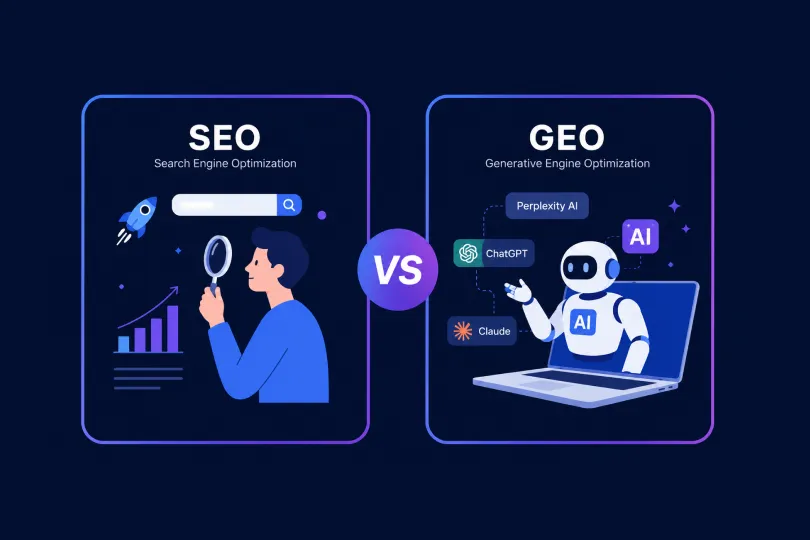
| Comparison point | SEO | GEO |
| Primary goal | Earn rankings, clicks, and conversions | Earn retrieval, citations, and influence in generated answers |
| Retrieval engine | Search index, ranking systems, and query matching | Semantic retrieval, vector similarity, reranking, and retrieval-augmented generation |
| User journey | Search, results page, click, website, conversion | Prompt, synthesized answer, citation or mention, optional click, conversion |
| Key metric | Qualified organic traffic and pipeline | Share of model voice, citation rate, and assisted pipeline |
The table above is the clean version of the concept, but real life is slightly messier. Of course, traditional search results aren’t perfectly deterministic. Rankings will always be influenced by device, location, intent, freshness, and a list of other variables long enough to ruin a perfectly good lunch break. However, they’re still relatively observable. With the right tools, you can track impressions, positions, clicks, landing pages, conversions, and revenue.
Generative answers are a bit more slippery. The model may use different sources when the question is rephrased. It may cite your article once, mention a competitor the next time, then produce a third answer that sends everyone back to the drawing board.
Google confirms that its generative search features can use different models, techniques, and related searches to build responses. That means the supporting links can vary.
This is why the GEO vs SEO discussion is not simply “keywords versus vectors.”
- SEO asks: Can the right buyer discover this page, click it, and convert?
- GEO asks: Can an answer engine retrieve this information, trust it, and use it to shape the response?
It should go without saying that you’re still going to need keywords to shape your website’s content. But in the age of AI, you also need entities, topical relationships, factual clarity, and information that deserves to be retrieved.
The DEO Decision Matrix: When To Optimize For Clicks Versus Citations
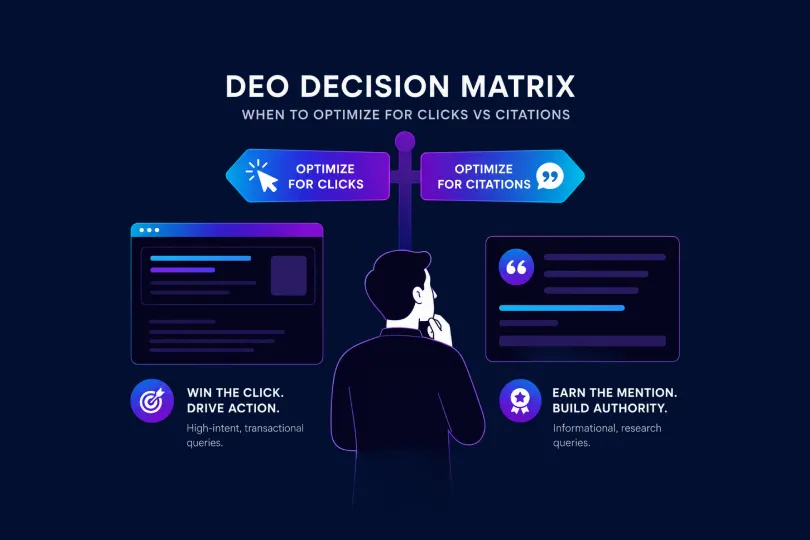
Trying to give every page an equal SEO and GEO weighting sounds balanced, but we can tell you from experience that it’s a tidy way to waste time. The right “balance” depends on what the person on that page is trying to do.
1. High-Intent Transactional Queries: SEO First
When someone wants a provider, demo, quote, product, or location, the commercial page needs to win the click.
Think:
- “Enterprise cybersecurity platform”
- “Dallas B2B SEO agency”
- “Book payroll software demo”
- “Best CRM for manufacturing companies”
These searches have buying intent, so your priority must be a page that loads quickly and gives the buyer somewhere sensible to go next. GEO still matters here, but it plays support. You can add concise comparison points, specs, and FAQs to improve citations without turning the landing page into an academic journal.
The bottom line is revenue pages need to sell, not merely sound informative.
2. Broad Research & Definitional Queries: GEO First
Some questions can be answered without a website visit. Questions about definitions, comparisons, trends, and early-stage problem diagnosis are just a few of them. These are the prompts that feed AI answers, featured snippets, and long-winding research journeys.
For example, someone asking, “What is GEO in SEO?” may get a complete explanation inside ChatGPT or Google AI without clicking through to a source. In that moment, the commercial win is not always the visit. It’s having your definition or point of view shape the answer and place your brand in the buyer’s research path.
Here, the page wins by becoming the clearest source. Some of our GEO recommendations include:
- Give the direct answer early.
- Add a comparison table.
- Define terms consistently.
- Cite primary research.
- Include examples.
- Explain limitations.
Most importantly, and we can’t stress this enough: contribute something new.
A generic summary gives an answer engine little reason to choose your page over the 400 versions already online. A useful framework, original data point, tested process, or sharp decision rule gives it something worth carrying forward.
3. Deep B2B Technical Queries: Dual-engine From Day One
Complex B2B questions rarely fit neatly into one lane. For instance, consider a buyer researching, “What’s the best CRM for a 200-person SaaS company that needs cleaner attribution and fewer duplicate records?” That search may need:
- A straightforward explanation
- Technical architecture
- Security and integration considerations
- Vendor comparisons
- Implementation risks
- Evidence for finance, IT, and senior leadership
That content should rank, but it should also be retrievable. This is where DEO earns its keep. If you operate in such a market, we recommend you build one authoritative resource with clear sections, precise definitions, diagrams, comparison tables, examples, limitations, and strong internal links.
Organic clicks show active demand, and model citations extend your influence into questions that keyword tools may never record. Together, they can support branded search and longer B2B buying journeys.
The article should not finish its job at “we got cited.” Your board is unlikely to approve another quarter because the brand enjoyed a flattering afternoon in Perplexity. Visibility needs to connect to commercial movement.
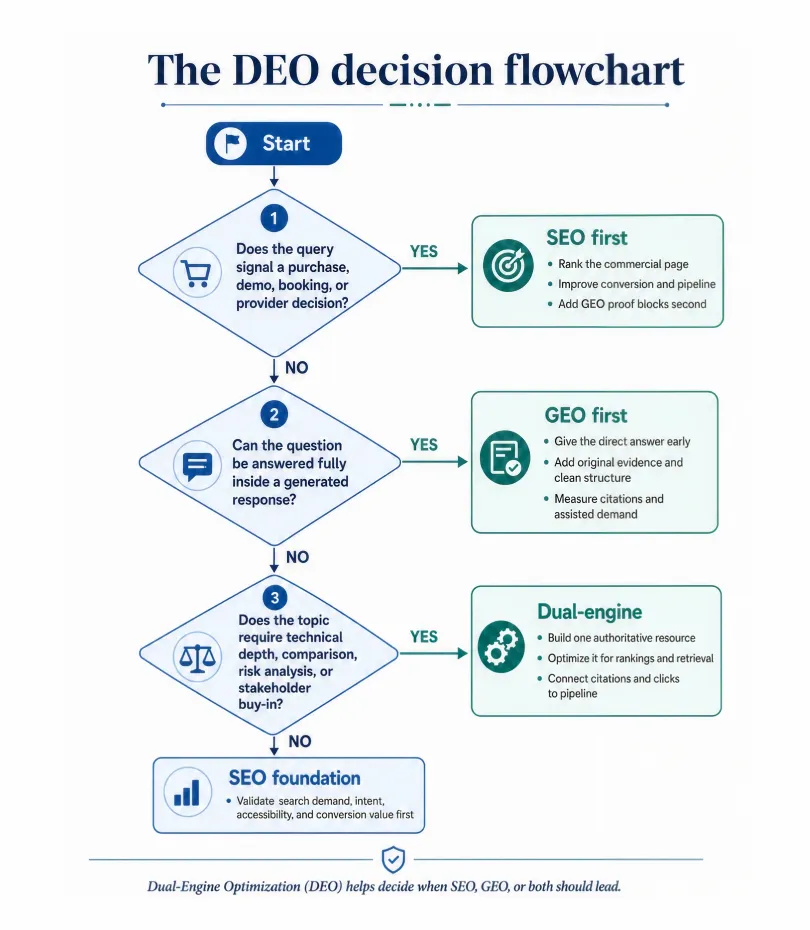
The DEO Decision Flowchart
Sample infographic:
Step-by-Step Playbook: Engineering Content For Both Engines
At OMG, our DEO service applies our evidence-driven SEO methodology through the TLC Framework: Technical, Links, and Content. The aim is not to bolt a trendy GEO checklist onto an old SEO plan, but to make every useful asset discoverable and commercially accountable.
Step 1: Increase Information Gain & Factual Density
Your page needs a reason to exist.
An information gain score is our working measure of how much useful, non-duplicative value a page adds beyond the existing results. It’s not an official score supplied by Google, OpenAI, or any other platform.
Review the current answer set and ask:
- What’s missing?
- What has been oversimplified?
- What can we prove?
- What have we learned through experience?
- What would make this useful in a real decision?
Add original examples, research, expert observations, benchmarks, risks, and limitations. Google’s current guidance emphasizes valuable, unique, non-commodity content. In plain English, another article rearranging the same six points is unlikely to set the world on fire.
Step 2: Structure Content For Machine Parsing
Machine-friendly content is often reader-friendly content wearing sensible shoes. You see, generative systems don’t always process a page from top to bottom. They may retrieve only the passages most relevant to a query, then use those passages as evidence.
This is called retrieval-augmented generation, or RAG, and it combines a language model with information retrieved from an external source. The model uses that retrieved material to help construct its answer. Therefore, each self-contained passage on your page should make sense when pulled away from the rest of the article.
Here are some actionable tips to consider:
- Use descriptive headings.
- Put the answer near the question.
- Keep definitions consistent.
- Use tables for comparisons and numbered steps for processes.
- Place evidence beside the claim it supports.
- Do not bury the important answer beneath five paragraphs of scene-setting, a personal anecdote, and a sudden history lesson about the internet.
That being said, you have to avoid chopping every thought into tiny “AI-ready” fragments. Google advises focusing on useful content and readable structure, rather than inventing special formatting purely for AI systems. You can’t prioritize gaming the system and expect the content to stay useful for people.
Step 3: Clarify Entities & Apply Schema Markup
An answer engine should know who you are, what you do, and why the claim belongs to you. You can start building entity clarity through:
- Consistent company, product, and service names
- Complete author biographies
- Relevant credentials
- Connected case studies
- Clear About and Contact information
- Strong internal linking
- Accurate structured data
Schema markup provides explicit clues about the meaning of a page. It can help search systems classify companies, people, products, articles, and other entities. However, it’s not a shortcut to authority. Adding Organization schema to a company with no credible footprint is like printing “industry leader” on a name badge. Technically possible. Socially ambitious.
Google also states that no special GEO schema is required for its AI search features. Anyone selling a “secret” markup type is likely charging you for a lever that doesn’t exist.
Step 4: Protect Technical Crawler Accessibility
AAs GEO became more prominent, many wondered if it would eventually replace traditional SEO. The answer is no, simply because GEO still depends on the foundations SEO provides. A page cannot become a dependable source when search systems cannot access, render, understand, or index it.
Things to review:
- Robots.txt rules
- Meta robots directives
- Canonicals
- Status codes
- Internal links
- JavaScript rendering
- XML sitemaps
- Duplicate content
- Important text hidden inside images
- CDN and firewall restrictions
A page needs to be indexed and eligible for Search before it can appear as a supporting link in Google AI Overviews or AI Mode. The same technical SEO foundations still apply. However, ChatGPT has its own search crawler. OpenAI advises not to block OAI-SearchBot if you want content surfaced linked in ChatGPT searches.
Don’t forget to review crawler policies with your legal, security, and technical teams. Do not blindly open everything. Do not accidentally block everything either.
Step 5: Build Digital PR & Third-Party Co-Occurrence
Your website tells systems what you claim. The wider web helps them decide whether anybody else agrees. To bridge that gap, your strategy needs to build credible associations between your brand and target topics through:
- Original research
- Expert commentary
- Editorial coverage
- Industry associations
- Partner pages
- Relevant directories
- Reviews
- Podcasts
- Conference appearances
- High-quality links
At OMG, we map all this through an LLM citation graph where each node represents a brand, expert, topic, product, or source. Each connection represents a citation, link, mention, or recurring association.
A strong graph links your brand to the subjects you want to own through credible sources. A weak one consists of your own website repeating the claim 17 times and a press release syndicated across websites nobody has voluntarily visited since 2013.
KPIs For GEO vs SEO
The old SEO dashboard is not enough for DEO. You need to measure the two engines according to the jobs they perform.
| SEO KPI | What it tells you |
| Qualified organic conversions | Whether search creates demos, leads, sales, or bookings |
| Organic pipeline and revenue | Whether SEO contributes commercial value |
| Non-branded visibility | Whether you are reaching buyers beyond existing brand demand |
| Priority keyword coverage | Whether commercially useful topics are becoming discoverable |
| Landing-page conversion rate | Whether the traffic is doing anything useful |
| Customer acquisition cost | Whether organic growth improves blended efficiency |
| GEO KPI | What it tells you |
| Share of model voice | Your brand’s share of mentions or citations across tracked answers |
| Citation rate | How often your website appears across priority prompts |
| Citation quality | Whether the citation supports an important claim or merely decorates the answer |
| Prompt coverage | How many research, comparison, and buying prompts surface the brand |
| LLM citation graph growth | Whether credible sources connect your brand to target topics |
| AI referral conversions | Whether answer-engine visibility creates valuable website activity |
| Assisted branded demand | Whether visibility precedes branded search, direct traffic, or pipeline |
FAQs on GEO & SEO
SEO improves a page’s ability to be crawled, indexed, ranked, clicked, and converted. GEO improves its probability of being retrieved, understood, cited, or used inside a generated answer.
SEO focuses heavily on search visibility and website outcomes, while GEO adds answer-level visibility, citations, and model mentions. DEO combines both around one commercial strategy.
No. GEO depends on many of the same foundations as SEO, including crawlability, indexation, relevance, authority, and useful content. Google itself states that its generative search features still rely on core Search systems and indexed web pages. GEO changes how content is constructed and measured, but it doesn’t remove the need for technical SEO or strong commercial pages.
Start by classifying your priority queries. Use SEO-first treatment for transactional intent and use GEO-first treatment for answerable research questions. Use a dual-engine approach for complex B2B topics.
With that sorted, focus on improving information gain, page structure, entity clarity, crawler access, and third-party authority. Track traditional SEO performance alongside citation rate, share of model voice, and assisted demand.
SEO KPIs include qualified traffic, conversions, pipeline, revenue, keyword coverage, and acquisition efficiency. GEO KPIs include citation rate, citation quality, prompt coverage, share of model voice, LLM citation graph growth, AI referrals, and assisted branded demand.
Neither should stop at visibility. Both sets of metrics should connect to commercial outcomes wherever your attribution allows.
Stop Choosing Between Clicks & Citations; Build a Dual-Engine Strategy With OMG
The SEO vs. GEO debate makes for a lively webinar title, but it’s less useful when your revenue is on the line. Your buyers move between ranked results, AI answers, vendor websites, LinkedIn posts, and more. Your search strategy needs to move with them.
Online Marketing Gurus brings 14+ years of performance experience and 200+ specialists across digital marketing disciplines. We can show you where SEO should lead, where GEO should take over, and where both need to work together to influence the bottom line.
Download the DEO Content Audit Checklist to score your content now, or book a Dual-Engine SEO Audit, valued at $3,000 and delivered within 48 hours. You may also reach out to us for questions or explore our case studies.

About the author
Read More Blogs
-


Last updated on:
-
18 minutes read
Social Media Advertising in Dallas Fort Worth: How to Measure Facebook, Instagram and LinkedIn Ads by Revenue
Last updated on:
-
27 minutes read
Digital Marketing in Dallas-Fort Worth: How Local Businesses Can Turn Market Growth Into Measurable Revenue
Last updated on:


Stop Guessing What Your Marketing Should Do Next.
Your free $4,000 strategy session shows where your digital marketing is leaking performance across search, paid media, content and conversion. You leave knowing what to fix first and what a stronger strategy could produce.